


You have found an image you love and the listing says “poster” in one shop and “fine art print” in the next, sometimes at ten times the price. You want to know whether the difference is real or whether it is just a word on a product page.
This guide breaks the two apart using things you can measure and check: paper weight in gsm, how the ink gets onto the sheet, whether the run is open or limited, how each ages, and what each costs to frame properly. You will also get a 10 point test you can run on any print in your hands, plus honest advice on when a poster is the better buy.
Short answer: A poster is usually a mass-produced offset print on thin, 130 to 200 gsm paper, made to be cheap and replaceable. An art print is made in small runs or to order, on heavier archival paper or canvas, with pigment inks that resist fading. Both can look good, but they are built for different lifespans.
Key takeaways
- The words “poster” and “art print” are not regulated in Australia, so judge by paper weight, ink and print method, not the label.
- Posters are typically offset printed on 130 to 200 gsm paper; quality art prints sit at 250 gsm and above on cotton rag, or on a heavy cotton canvas.
- Pigment inks on archival media are the main reason an art print keeps its colour indoors for decades.
- A poster is the right answer for a temporary display, a dorm, a rented space or anything you plan to swap within a few years.
- Framing a poster well often costs more than the poster, which changes the maths on “cheap”.
- Canvas Prints Australia does not sell cheap offset posters: everything is printed to order on archival pigment inks.
What exactly is a poster?
A poster is a printed sheet designed to be produced in large numbers and displayed, often temporarily. The format grew out of advertising, concerts, travel promotion and film marketing, where the goal was reach and low cost per copy rather than permanence. You can read the format’s history on Wikipedia’s poster entry.
Most posters are made with offset printing. A metal plate transfers ink to a rubber blanket and then to paper, with four process colours (cyan, magenta, yellow and black) laid down as tiny dots. Setting up the plates is expensive, so offset only makes sense for runs of hundreds or thousands, which is why a poster can be sold for a few dollars. The offset printing overview explains the process in more detail.
Typical poster characteristics:
- Paper weight around 130 to 200 gsm, gloss or satin coated, sometimes uncoated.
- Dye or standard offset inks chosen for cost and speed, not archival performance.
- Standard sizes such as A3, A2 or 61 x 91 cm so they fit cheap ready-made frames.
- Open edition: there is no cap on the run, and reprints are common.
None of that is a flaw. A poster is a sensible product for what it is built to do. The trouble starts when a poster is sold at art-print prices, or when a buyer expects a poster to behave like an archival piece.
What makes a print an art print?
An art print is a reproduction (or an original multiple) made with the intention that it will be kept and displayed for a long time. There is no legal definition, so the term only has meaning when the maker backs it with materials and process. In practice a credible art print has four things in common.
- Heavier, archival substrate. Cotton rag paper from roughly 250 to 310 gsm, or a cotton canvas with a proper protective coating.
- Pigment inks. Particles of pigment sit on or in the surface rather than dye dissolved in liquid, which resists light and humidity far better.
- Controlled colour. The file is prepared, soft-proofed and printed on a calibrated large format printer rather than run through a general press.
- Small or made-to-order runs. Because digital pigment printing has no plate set-up, each print can be produced on demand.
The technical name for this digital pigment process is often “giclee”. If you want the full meaning and the limits of that term, or a way to judge any seller, read our guide to what a giclee print actually is.
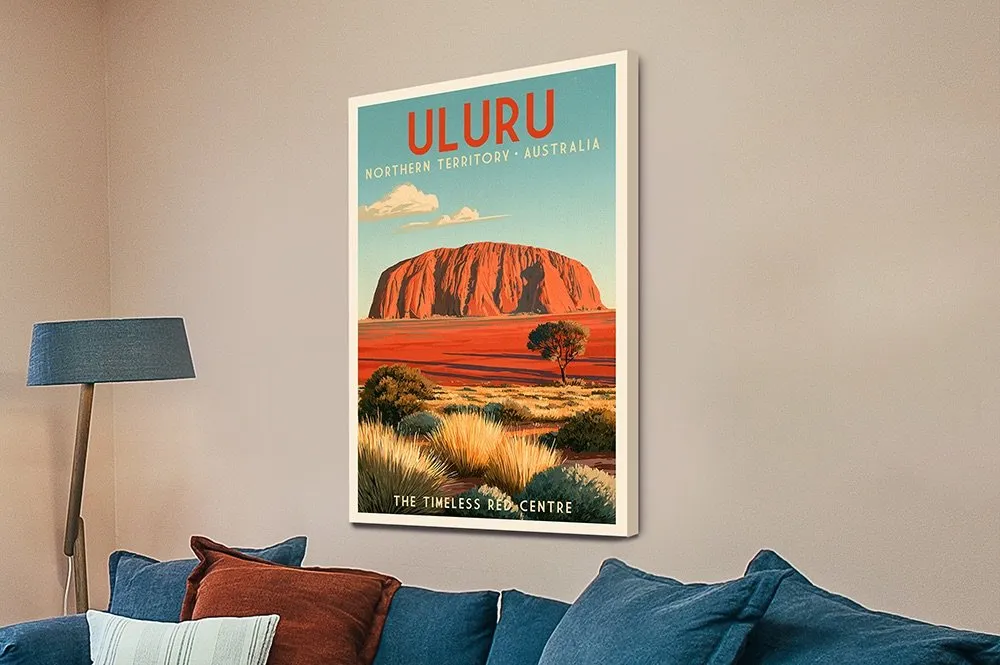 The Uluru Travel Poster shows how a classic poster design can be reproduced on archival media instead of thin offset paper.
Poster vs art print: the side-by-side comparison
This table uses typical industry ranges for the poster column, and Canvas Prints Australia’s own materials for the art print columns. Individual products from other sellers vary, so treat the poster figures as a guide, not a rule.
| Feature | Typical poster | Framed matt paper print | Lustre photographic print | Cotton canvas print |
|---|---|---|---|---|
| Paper or media weight | 130 to 200 gsm | 160 gsm matt paper | 260 gsm lustre satin | 390 gsm cotton canvas |
| Print method | Offset, in large runs | Archival pigment inkjet, printed to order | Archival pigment inkjet, printed to order | Archival pigment inkjet, printed to order |
| Inks | Standard offset or dye inks | Pigment (12 colour) | Pigment (12 colour) | Pigment (12 colour) |
| Surface | Gloss or satin coating | Soft, smooth matte | Satin with a fine sheen | Textured weave plus UV laminate spray |
| Edition | Open, unlimited | Made to order | Made to order | Made to order |
| Indoor lifespan | Often noticeable fading in years if lit or sunlit | Many decades indoors, out of direct sun | Many decades indoors, out of direct sun | Many decades indoors, out of direct sun |
| Handling | Creases and tears easily | Sturdy but needs framing | Sturdy but shows fingerprints | Tough, no glazing needed |
The decisive row is the lifespan one, and it comes from the ink, not the label. We come back to that in the longevity section, because this is where marketing and fact drift furthest apart.
Paper weight in gsm: what the number tells you
GSM means grams per square metre. It is a measure of mass, not quality, but within a product type it is a useful clue to how the sheet will feel and behave.
Rough guide to common weights
- 90 to 130 gsm: office or flyer paper. It buckles with any moisture and shows through light.
- 150 to 200 gsm: a typical poster. It feels like a thick magazine page and will ripple in a frame without support.
- 250 to 310 gsm: the range for serious fine art and photographic papers, including our 260 gsm lustre and the Moab 290 gsm rag paper available on request. It stays flat, resists dents and feels like card.
- 350 gsm and above: heavy watercolour-style stock, or in the case of canvas, a woven fabric rather than paper.
Why gsm alone can mislead
A 300 gsm wood-pulp sheet is not the same as a 290 gsm cotton rag sheet. Cotton fibre is naturally acid free and stable, while wood pulp needs additives to behave. So the second question after “how many gsm?” is “what is it made from?”. Rag paper is made from cotton fibre, which is why it sits in the archival group rather than just the heavy group. The Wikipedia page on rag paper covers the fibre background if you want to go deeper.
Inks and longevity: separating marketing from fact
This is the part of the topic where claims get inflated, so it helps to be precise about what is known.
What is well established
- Pigment inks are generally more light-stable than dye inks. This is a widely accepted principle across the photographic and fine art printing industry.
- Ultraviolet light and heat degrade nearly all printed colour over time. Cyan and magenta tones tend to shift first on lower quality prints, which is why an old poster left near a window often goes blue or yellow.
- Humidity and airborne pollutants affect uncoated and unprotected prints more than coated or glazed ones.
What you should be cautious about
- Specific lifespans such as “200 years” or “lifetime guaranteed”. These figures usually come from accelerated lab tests under particular conditions and rarely match a real Australian interior with a sunny window.
- “Museum quality” with no description of the paper, ink or glazing behind it.
- “Fade proof”. No print is fade proof.
Our own position is deliberately modest. Our Canon imagePROGRAF PRO printers use LUCIA 12 colour archival pigment inks, and the indoor display life is rated at many decades. We do not recommend hanging any print in direct sunlight, whatever it is printed on. If you want the climate-specific detail, see our guide on whether a canvas print will fade in Australian light.
Edition numbers, signatures and what “limited edition” means
People often assume an art print must be numbered. That is a different question from quality.
- Open edition: no cap on how many can be made. Posters are open edition. So is most reproduction art, including ours, which is printed on demand.
- Limited edition: the maker commits to a fixed number, usually numbered by hand (for example 14/100) and often signed. The scarcity is the value. This only matters if the work is by a living artist or an estate that controls the run.
- Artist proof: a small group outside the numbered edition, traditionally kept by the artist.
If a seller calls a reproduction of a public domain painting “limited edition”, ask who set the limit and whether it is documented. A reproduction of a 19th century painting has no natural scarcity, so the claim needs a very good explanation. If you are working with public domain images, our guide to famous art prints and public domain copyright explains what you can and cannot do.
 Travel-style artwork such as the Venice Travel Poster suits a heavy cotton paper or a textured canvas when you want it to last.
The 10 point in-hand test: poster or art print?
If you can hold the print, or if a seller will answer specific questions, run through this list. Score one point for each answer that points to an archival art print.
- Flex the corner. Poster paper bends softly and holds a crease. Heavy rag paper springs back and resists creasing.
- Check the edge thickness. Hold the sheet edge-on to a light. A 260 gsm sheet is clearly thicker than a 150 gsm one.
- Look at the surface under a bright light. A glossy, mirror-like coating suggests a poster. A soft matte or fine satin surface suggests photographic or fine art paper.
- Use a loupe or phone macro. Offset posters show a rosette pattern of dots. Inkjet prints show smooth gradients or an irregular micro dot pattern, with no regular rosette.
- Read the listing for ink type. “Pigment” or “archival” is a good sign. “Premium quality inks” tells you nothing.
- Look for the paper material. “100% cotton” or “cotton rag” beats an unnamed “art paper”.
- Check the border. Fine art prints often carry a white border so a mat or frame can overlap the edge without cutting into the image.
- Ask about the run. Open edition and printed on demand is normal. A claim of limited edition needs numbers and documentation.
- Notice the coating. A slick, plasticky coating or a strong chemical odour points to cheap mass finishing. Archival paper has almost no smell.
- Check the seller’s returns and care information. Serious makers explain handling, framing and light exposure, as in our guide to judging print quality. A seller who says nothing about it is selling a commodity.
Scoring: 8 to 10 points is almost certainly an art print. 4 to 7 is a mixed product, such as a heavier poster. 0 to 3 is a standard poster, and the price should reflect that.
When a poster is the better choice
It would be dishonest to pretend art prints win every time. A poster is the smarter buy in several situations.
- Short-term display. A student house, a pop-up event, a rental you will leave within twelve months.
- Rotating decor. If you like to change what is on display every season, a cheap poster is easier to justify.
- Kids’ spaces. A bedroom where artwork will be torn, taped and replaced is not the place for a framed archival print.
- Testing a layout. Printing cheap versions of images to try sizes and positions before committing is a reasonable workflow. A paper template cut to size does the same job for nothing.
- Ephemera by design. A concert or event poster is a souvenir of a moment. Collectors sometimes prize the original offset run precisely because it was cheap and period-correct.
An art print wins when you plan to keep the piece, when it will hang somewhere with real light, when you are framing it, or when the artwork matters to you. A good rule: if the framing will cost more than the print, spend more on the print.
Where our prints sit on the scale
Canvas Prints Australia is an Australian owned print studio that has operated since 2010, with production studios in Noosaville on the Sunshine Coast and Booragoon in Perth. We do not sell cheap offset posters. Every product is printed to order in Australia on archival pigment inks, so the table above is a fair description of what you receive. Our catalogue of more than 11,000 designs includes classic masterpieces, photography and film art.
Paper prints
Our paper options cover almost every need. Gallery reproductions and photography are printed on 260 gsm photo lustre paper, and Moab 290 gsm archival rag paper is available on request through our contact us page. Paper prints are posted in a sturdy tube, you frame them yourself, and they carry no hanging hardware.
Framed prints
If you want to skip the framing step, a framed print uses premium 160 gsm matt paper in a timber frame with a clear 3 mm Shinkolite acrylic front. A choice of frame colours and a 20 mm white printed border are selected on the product page. Our framed art collection shows the range.
Canvas
A canvas print uses 390 gsm cotton canvas with archival pigment inks and an invisible UV laminate spray, stretched over a 1.5 inch (38mm) thick kiln-dried pine stretcher frame. It needs no glazing and no frame to hang. The comparison with paper has its own page, lustre paper vs canvas prints, and a broader look in our canvas versus paper article.
 Film artwork like the Good Will Hunting Movie Poster Print is a case where a framed archival version replaces a thin original.
Framing: the hidden cost that changes the comparison
A thin poster in a ready-made frame looks fine for a few months, then starts to ripple. The usual cause is that thin paper has no stiffness, so it moves with humidity and temperature. A heavier paper sheet stays flat, but it still needs the right frame.
What a proper frame for a paper print involves
- Glazing: acrylic or glass to protect the surface. Our framed prints use 3 mm Shinkolite clear acrylic, which is lighter and stronger than glass with similar clarity.
- A border or mat: so the image does not touch the glazing. A 20 mm white printed border is our recommended default. Framed prints are not offered in the very largest size.
- Backing and hanging hardware: D rings and wire for the weight of the frame.
If you are framing locally, bring the print flat or in its tube, ask for acid free materials, and avoid dry mounting rag paper to a board with adhesive, since this cannot easily be undone. Our borders, mounts and framing guide explains each option, and choosing a frame colour for art prints helps with the finish.
The honest cost picture
Custom framing a standard poster size often costs more than the poster itself. Buying a decent print and a decent frame means two purchases, but the pair lasts years. Buying a cheap poster and a cheap frame means you will probably replace both. That is why a framed paper print or a canvas is often better value than it looks on a price tag.
Choosing a size so the print does not look lost
Poster sizes are built around cheap standard frames, which pushes many people into sizes that are too small for the space. Our stated guidance is that the most common regret is going too small.
| Situation | Suggested size | Reason |
|---|---|---|
| Above a 1.8 m sofa | Roughly 1.2 to 1.35 m of art in total width | Art should be about two thirds to three quarters the width of the furniture below |
| Bedroom | Medium to Large (18 x 27 in up to 24 x 36 in) | Reads well from the bed without overwhelming the space |
| Hallway | A run of Smalls or a panoramic | Narrow space suits repeated or long formats |
| Office | Small to Medium | Viewed at close distance |
Hang so the centre of the artwork sits about 145 cm from the floor, which is standard gallery eye level, and leave 15 to 25 cm between the bottom edge and furniture. The canvas print size guide shows every standard size with centimetres, and the article on choosing the right size walks through measuring.
Step by step: how to buy the right one
- Decide how long you plan to keep it. Under two years, a poster is fine. Beyond that, buy archival.
- Decide where it will hang. Bright light, a kitchen or a bathroom favour canvas with a protective coating or a glazed frame over bare paper.
- Pick the format. Paper in a frame suits detailed artwork and photography. Canvas suits painterly artwork and bold colour, and needs no glass. Our canvas versus framed guide helps with this step.
- Measure the space. Use paper templates taped up for a day.
- Check the specifications. Ask for paper weight, material and ink type. Disregard vague adjectives.
- Check what is included. Frame, glazing, hanging hardware, border. A cheaper price may leave all of these out.
- Review the returns policy. Made-to-order items usually cannot be returned for change of mind, so check the size twice. Ours cover damaged, faulty or incorrect items in line with the Australian Consumer Law, as set out on the returns and refunds page.
Vintage travel, movie and exhibition posters: a special case
Some artwork is famous because it was a poster. Vintage travel designs, film one-sheets and gallery exhibition announcements come from a time when posters were the only way to reproduce a bold design cheaply. Reproducing them well is a different job from owning the original.
- Genuine period originals are collectables. They are fragile, usually folded, and often restored. Value depends on condition and rarity, which is a specialist market.
- Reproductions let you enjoy the design at a good size without handling a fragile antique. The best approach is a faithful colour reproduction on a paper or canvas that will not yellow.
Designs such as the Uluru Travel Poster and the Good Will Hunting Movie Poster Print show the range. Our vintage poster prints and framed vintage movie posters are printed to order in the sizes of our standard ladders, and exhibition posters offer another route into the style. If you are curious about how cinema artwork was originally produced, read how movie posters are made, and for sizing, how big movie posters are.
 The Interstellar Poster is the sort of film artwork that looks sharper as an archival print than as a thin store-bought sheet.
Looking after the print once you have it
Keep any print out of direct sun, away from heat sources and out of steamy bathrooms. Dust canvas with a soft dry cloth, and clean framed acrylic with a microfibre cloth, never spraying onto the frame. We cover this in more depth in our guides on caring for prints in Australia’s climate and how to clean canvas prints.
Frequently asked questions
Is a poster the same as an art print?
No. A poster is usually an offset print on thin paper made in large runs. An art print is usually made on archival paper or canvas with pigment inks, often to order, and is intended to last.
How can I tell if a print is a poster or an art print?
Check the paper weight, the ink type and the print method. Under 200 gsm with a glossy coating usually means a poster. Cotton rag or canvas with pigment inks means an art print.
What gsm is a good art print paper?
Fine art and photographic papers generally sit between 250 and 310 gsm. Ours are 260 gsm lustre for gallery reproductions and photography, and 160 gsm matt paper for framed prints, with Moab 290 gsm rag paper on request.
Are art prints worth the extra cost over posters?
They are if you plan to keep the piece for years or frame it. The price gap narrows once you add proper framing, because a thin poster still needs the same glazing and mat as a heavy print.
Do posters fade faster than art prints?
Often, yes. Offset and dye inks are generally less light-stable than archival pigment inks, so a poster in a bright space can show colour shifts sooner. No printed item should hang in direct sunlight.
Does an art print have to be signed or numbered?
No. Signatures and edition numbers apply to limited editions by artists. Reproductions made on demand are normally open edition, and their value comes from the materials and colour accuracy.
Can I frame a poster the same way as an art print?
Yes, but thin paper needs a mat or backing board to stay flat. Heavier cotton rag stays flat more readily and gives the frame a cleaner, crisper look.
What is the best way to hang a print without a frame?
Canvas is the easiest option because it arrives stretched with hanging hardware. A paper print needs a frame or a purpose-made clip hanger, since pins and tape damage the sheet.
Does Canvas Prints Australia sell posters?
We sell reproductions of classic posters, such as vintage travel and film designs, but we print them on archival media to order. We do not sell cheap offset posters.
Can I send you a poster image I already own?
You can send an image you are unsure about and our team reviews it free before printing. Supply it at the actual print size as a TIFF or high quality JPEG, and check it first with the free photo resolution checker.
Choosing between a poster and an art print
Choose a poster for temporary, low-stakes display, and choose an art print for anything you want to keep, frame or enjoy in good light. The label matters less than the paper, ink and process behind it, so use the 10 point test and ask for specifications.
If you decide on archival, browse our bestsellers or the full art categories, and check sizes in the Size and Price Guide. Our team at [email protected] or 1300 632 332 can answer questions on paper, framing and sizing before you order.
Browse every guide in our series on the canvas print guides page.
