


Start with a tape measure. Suppose you have an alcove 1,000 mm wide, and you want a piece of art that sits in it with breathing space on both sides. A frameless canvas that is 91 cm wide fits easily. The same artwork in a floating frame becomes wider, because the frame adds to the outer size. A framed print adds its own frame as well. The finish you choose changes the footprint, the look and the way light plays across it.
This guide compares three ways of finishing artwork: a floating frame around a stretched canvas, a standard framed print behind clear glazing, and a frameless stretched canvas. You will see exactly how each is built, how much each adds to the outer size, what happens with glare and handling, and which style suits which artwork. A decision table and a short checklist at the end help you commit.
Short answer: Choose a floating frame when you want a canvas to look framed without covering the image, a standard framed print when the artwork is on paper and needs glazing and a border, and a frameless stretched canvas when you want a light, modern, ready-to-hang piece. A floating frame adds to the outer size on every side.
Key takeaways
- A floating frame is a stretched canvas set in a floating frame, with a small visible gap around the canvas that makes it appear to float.
- The frame adds to the outer size on every side, and the product page lists the outer dimensions.
- Standard framed prints use paper behind 3 mm Shinkolite clear acrylic, with a 20 mm white printed border for breathing space.
- Frameless stretched canvas is the lightest and simplest option and needs no glazing, so it has the least glare.
- Frame colour should follow the artwork, not the furniture, with warm tones for warmth, black for contrast and white for lightness.
The three finishes explained
Floating frame canvas
A floating frame starts with a stretched canvas, then places it in a floating frame, a premium contemporary finish. Frame colour options are on the product page. A small visible gap, called the reveal, sits between the canvas edge and the inside of the frame, which makes the canvas appear to hover. The result is ready to hang.
The canvas inside is the same quality as our standard stretched canvas: premium-grade archival 100% cotton, 390 gsm, with archival pigment inks and an invisible UV laminate spray. The frame simply adds a border of timber around it.
Standard framed print
A standard framed print is a paper print behind clear glazing in a timber frame. Ours uses premium 160 gsm matt paper in a timber frame, with a choice of frame colours on the product page. The glazing is 3 mm Shinkolite clear acrylic, which is lighter and stronger than glass with similar clarity. It is ready to hang with D rings and wire.
Frameless stretched canvas
This is the classic gallery-style canvas. The print is stretched over a 1.5 inch (38mm) thick kiln-dried pine stretcher frame, protected with an invisible UV laminate spray, and fitted with D rings, picture wire and felt corner bumpers. There are three wrap options at the same price: a mirror wrap, a gallery wrap in which part of the image wraps around the timber, or a coloured border in black or white. See the wrap options page for visuals, what canvas prints are made of for the materials, and the canvas print overview for general background.
If you want a general comparison of canvas and framed paper before going deeper, our article on canvas versus framed prints is a good starting point.
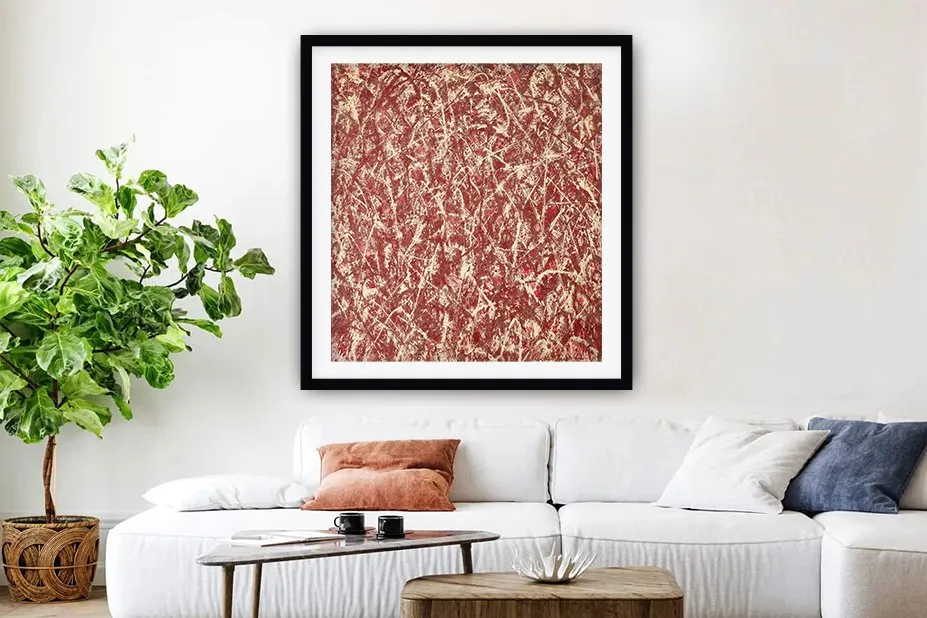 Abstract work such as Lee Krasner Untitled 2 can sit comfortably in a floating frame, where the edge detail stays visible.
Floating frame vs standard frame vs frameless: comparison
| Feature | Floating frame canvas | Standard framed print | Frameless stretched canvas |
|---|---|---|---|
| Printed on | 390 gsm cotton canvas | Premium 160 gsm matt paper | 390 gsm cotton canvas |
| Frame | Floating frame with a small visible gap, colour options on the product page | Timber frame, colour options on the product page | None, 1.5 inch (38mm) pine stretcher frame inside |
| Glazing | None, UV laminate sprayed canvas | 3 mm Shinkolite clear acrylic | None, UV laminate sprayed canvas |
| Added to outer size | Frame width on each side | Frame width, plus any border | Nothing: print size equals outer size |
| Border options | Reveal gap acts as a shadow line | 20 mm white printed border (recommended) or none | Mirror, gallery wrap or black or white border |
| Glare | Low, no glazing | More, acrylic can reflect light | Low, subtle sheen |
| Look | Gallery, finished, substantial | Classic, traditional, detailed | Light, modern, informal |
| Hang | Ready to hang | Ready to hang with D rings and wire | Ready to hang with D rings and wire |
| Best for | Painterly art, feature pieces, prominent spaces | Detailed art, film posters, photography | Most art, kids spaces, humid areas |
The sizing row is where people trip. The frame is built around the canvas, so the print size stays the same and the outer size grows. We show the maths next.
How the frame changes the outer dimensions
The frame is built around the canvas, so the canvas size stays the same and the outer size grows on every side. The floating frame gives a small visible gap around the canvas, and the exact outer dimensions for each size are listed on the product page. Always plan with those outer dimensions rather than the canvas size, because the difference matters in an alcove, above a sofa or between two other pieces.
Check the product page for the final published dimensions before you order. The same logic applies to both the 2:3 and 3:4 ladders and to other formats.
Why it matters for planning
- Furniture rule. We suggest art should be about two thirds to three quarters the width of the furniture below. Measure using the outer frame size, not the canvas size.
- Gaps between pieces. For a gallery arrangement we suggest gaps of 5 to 7 cm. With frames, measure from frame edge to frame edge.
- Alcoves and shelves. Leave at least a few centimetres of clearance each side, or the piece will look jammed.
- Shipping. A bigger outer size can affect the parcel. Check the shipping prices page for the size bands.
Our canvas print size guide lists every standard size, and the article on choosing the right size shows how to test with paper templates.
Matching the finish to the artwork
The right finish makes the artwork look intentional. These pairings are guidelines rather than rules.
Abstract and contemporary pieces
Floating frames suit abstract work because the reveal gap acts as a shadow line and lets bold colour run right to the edge. A black frame sharpens geometric designs and a natural timber frame softens expressive, gestural ones. Browse abstract and contemporary art, or look at pieces like Lee Krasner Untitled 2 and Shakespearean Sailor.
Film and travel posters
These designs are built around type and borders, and they suit a classic framed print with a white border. The glazing protects paper from handling. Our framed vintage movie posters are a good example.
Photography
Detailed landscape and black and white photography is usually best on paper in a framed print, where fine detail stays crisp. Canvas also works for photography, particularly bold landscapes, and a floating frame gives it a finished edge. The trade-offs between paper and canvas are covered in lustre paper vs canvas prints.
Modern art reproductions
Colour-led pieces, for example Blue II by Joan Miró, work well frameless with a mirror or gallery wrap, or in a floating frame for a more formal look. See more in modern art prints.
 Blue II by Joan Miró has large open areas of colour, which suit a frameless canvas or a slim floating frame.
Choosing frame colour and timber
Frame colour should serve the artwork first. Our full guide is choosing a frame colour for art prints, and this is the short version.
- Matt black: adds contrast and definition. It works with graphic, high-contrast and monochrome artwork and with strong, saturated colour.
- White: keeps the piece light and lets the colour carry. It suits pastel, botanical, coastal and Scandinavian-style interiors, and works well on light-coloured surfaces.
- Natural timber tones: adds warmth and a natural feel. It suits earthy palettes, landscapes and timber furniture.
A simple three-step test
- Pick the darkest and the lightest tones in the artwork.
- If the artwork has a strong dark outline or deep shadows, black repeats it. If the image is mostly light, white or a timber tone will not overpower it.
- Hold a strip of each colour against the artwork in daylight before deciding.
Keep other frames in the same space in mind. A mix is fine if the tones repeat, for example two black frames and one timber accent, but three different frame colours tends to look accidental.
Glare, light and the glazing question
Glazing changes how an image reads. A framed print has a clear acrylic pane in front of the paper. Acrylic is lighter than glass and strong, and gives similar clarity, but any glazed surface can reflect windows and lamps. A canvas has no glazing, and its protective coating gives only a subtle sheen, so there is far less mirror-like reflection.
Reducing glare on a framed print
- Hang the piece at right angles to the main window, not opposite it.
- Move lamps so they are not directly in front of the art.
- Choose a larger border so the eye is drawn into the image rather than the reflection.
- Avoid the brightest spot in the space, which also helps the print last. We do not recommend hanging any print in direct sunlight.
The full lighting guide is in reducing glare and lighting your artwork. If glare is your main worry, a frameless or floating canvas will almost always be the quieter choice.
Borders and the standard frame in detail
With a framed print you have choices that do not exist with canvas. Each changes the look and the usable image area.
- 20 mm white printed border (recommended): a clean white margin printed around the image. It keeps the image from touching the frame and is included at no extra cost.
- No border (full bleed): the image runs to the edge. It looks modern and bold, and suits photography and dense artwork.
- Size range: framed prints are not offered in the very largest size.
Choosing between them is partly a matter of artwork and partly taste. A detailed painting with its own border often benefits from a printed border, while a photograph that fills the frame often looks best without one. The borders, mounts and framing guide shows each with examples.
The wider question of how framed paper compares with canvas formats is explored in framed vs stretched vs framed paper print, and a broader view on frames versus no frame is in framed vs unframed canvas prints.
Weight, hanging and wall types
A floating frame adds timber to the canvas, so it is heavier than the same canvas alone. A framed print behind acrylic is lighter than the same print behind glass, which is one reason we use Shinkolite acrylic. For anything large, check the weight against your fixing.
- Use the D rings and wire supplied, and fit a hook or screw rated for the weight.
- Plasterboard needs a suitable anchor or a stud fixing for larger pieces. Brick, concrete and render need the right plug.
- Hang at about 145 cm from the floor to the centre of the artwork, which is standard gallery eye level.
Our guide to hanging a heavy canvas print covers Australian wall types in more detail.
 Shakespearean Sailor works as a frameless canvas for a relaxed look or in a floating frame for a more finished feel.
Care and cleaning for each finish
Each finish needs slightly different upkeep, and the differences are small but worth knowing.
- Floating frame: dust the canvas face with a soft dry cloth, and run a dry brush or the cloth along the reveal gap now and then so dust does not settle into it. Wipe the timber with a barely damp cloth, then dry it.
- Standard framed print: clean the acrylic with a soft microfibre cloth. Avoid paper towel and household glass sprays, which can scratch or cloud acrylic, and never spray liquid directly onto the frame.
- Frameless canvas: dust with a soft dry cloth and avoid pressing on the face.
For all three, keep artwork away from steam and heat sources, and out of direct sunlight. Climate-specific advice is in caring for canvas prints in Australia’s climate.
Honest trade-offs for each finish
Floating frame canvas
- Pros: looks finished, protects the canvas edge, no glazing glare, works with a wide range of artwork.
- Cons: larger and heavier than frameless, the reveal gap can collect dust over time, and the canvas edge is visible in the gap so the wrap choice matters. Check the product page for the wrap options available with the floating frame.
Standard framed print
- Pros: glazing protects the paper, a border option, a classic look, excellent for detailed work.
- Cons: reflections from glazing, acrylic can scratch if cleaned roughly, and production adds 2 business days for framed prints.
Frameless stretched canvas
- Pros: light, no glazing, quick to hang, and three wrap options at the same price.
- Cons: a less formal look, the edges are exposed to knocks, and the texture softens very fine detail.
Decision table: which finish for which situation
| Your situation | Best choice | Why |
|---|---|---|
| Bold abstract or colour-led artwork, prominent spot | Floating frame | Finished edge without covering the image |
| Film poster or vintage travel design | Standard framed print | Border and glazing suit paper and type |
| Detailed photograph or black and white image | Framed paper print | Fine detail stays sharp on smooth paper |
| Family area, hallway, kids space | Frameless canvas | Light, tough, no glazing to break or reflect |
| Humid area such as a bathroom or laundry | Frameless or floating canvas | Protected canvas is usually the more forgiving surface |
| Large piece above a sofa | Frameless or floating canvas | Lighter to hang; glare is lower in bright interiors |
| Tight alcove or narrow gap | Frameless canvas | Outer size equals print size |
| Formal or traditional interior | Framed print with white border | Classic gallery proportions |
Step by step: choose your finish
- Identify the artwork type. Painterly or abstract leans canvas, detailed or typographic leans paper.
- Measure the space. Use outer dimensions: check the product page for the floating frame outer size.
- Check the light. Strong reflections favour canvas, and soft light suits glazed paper.
- Pick the frame colour using the artwork’s darkest and lightest tones.
- Choose the border or wrap. White printed border for paper, mirror or gallery wrap for canvas.
- Check the fixing for the weight and your wall type.
- Confirm the timeline. Production is typically 3 to 4 business days, and framed prints add 2 business days.
Frequently asked questions
What is a floating frame for canvas?
It is a frame that holds a stretched canvas with a small visible gap around the edge, so the canvas appears to float inside it. Frame colour options are on the product page.
How much does a floating frame add to the size?
It adds to the outer size on every side, so the finished piece is larger than the canvas alone. The product page lists the outer dimensions for each size.
Does a floating frame cover any of the image?
No. The frame sits outside the canvas, and the reveal gap leaves the canvas edge visible, so the full printed image stays in view.
Is a floating frame better than a standard frame?
Neither is better in general. Floating frames suit canvas and painterly artwork, while standard frames with glazing suit paper prints, posters and detailed photography.
Do framed prints use glass?
No, ours use 3 mm Shinkolite clear acrylic. It is lighter and stronger than glass with similar clarity, though it can scratch if cleaned roughly.
Can I add a frame to a frameless canvas later?
Our floating frame is supplied with the canvas as a ready-to-hang piece, so choose it when you order. If you plan to frame later with a local framer, ask about the outer dimensions first.
Which frame colour is the safest choice?
Black is the most versatile for contrast, white suits light interiors and a natural timber tone suits warm palettes. The best test is to hold a strip of each against the artwork in daylight.
Do framed prints reflect more than canvas?
Yes. A glazed print can reflect windows and lamps, while a canvas has only a subtle sheen. Position and lighting reduce the effect on either.
Is every size available as a framed print?
No, framed prints are not offered in the very largest size. The 20 mm white printed border is the recommended option on the product page.
Are floating frames and framed prints ready to hang?
Yes. Both arrive ready to hang, with D rings and wire on framed prints and hanging hardware included. Choose a fixing suited to the weight and your wall type.
Choosing the finish that suits your artwork
Pick the floating frame for canvas that deserves a finished, gallery look, the framed print for paper artwork that needs glazing and a border, and the frameless canvas when you want the lightest, simplest and least reflective option. Plan the space using outer dimensions and let the artwork, not the furniture, choose the colour.
You can explore framed art or compare finishes on a specific canvas by reading stretched canvas vs rolled canvas. For help with sizing or colour, email [email protected] or call 1300 632 332 and our team will help before you order. If anything arrives damaged, faulty or incorrect, we replace or refund it in line with the Australian Consumer Law guarantees, as set out on our returns page.
To see how finish and frame choices play out with a real subject, read how industrial photography can bring character to modern interiors.
Browse every guide in our series on the canvas print guides page.
