



The removalists arrive on Friday, and the art is the part of the move you cannot replace. A cracked corner on a sofa is annoying. A creased print or a dented stretcher bar on something you chose with care is a different kind of loss. The good news is that artwork is easy to protect once you know what actually causes damage.
This guide covers how to pack, carry, drive and store canvas prints, framed prints, floating frames and paper prints, with Australian conditions in mind: humid garages, hot cars and sheds that cook in summer. You will find a materials list, a step by step packing method, a moving house checklist, a storage do and avoid table and the mistakes that cause most damage.
Short answer: Wrap each print in clean paper or soft cloth, protect the corners, add cardboard on both faces and stand it upright on its long edge, never flat under weight. Keep it out of heat, humidity and direct sun. In a car, carry it in the cabin, not a hot boot. For storage, choose a cool, dry, stable space.
Key takeaways
- The biggest threats are impact on corners, pressure on the face, heat, humidity and direct sunlight.
- Stand prints upright on the long edge, with cardboard between each one. Do not stack flat or lean them under other objects.
- Use paper or soft cloth against the print surface. Avoid plastic touching the surface for long term storage.
- A car boot or garage in summer can be far hotter than the outside air, so treat them as hazards.
- Framed prints need the clear acrylic protected from scratches and pressure, and corners cushioned.
- After a move, let the art settle at room temperature before you unpack it fully, then inspect it.
What actually damages prints when you move or store them?
Most problems fall into five categories. If you protect against these, you have covered nearly everything.
- Corner and edge impact. Dropped or bumped corners dent stretcher bars and chip frames. Corners are the most vulnerable part of any print.
- Pressure on the face. Something pressing on the front, such as a box corner, a heavy item or a tight strap, can dent canvas or scratch acrylic.
- Heat. Heat softens protective coatings, stresses timber and glue and can make materials expand at different rates. Closed vehicles and sheds can get very hot in an Australian summer.
- Humidity and moisture. Damp air can lead to mould, rippled paper and a sagging canvas. Humid garages, subfloors, bathrooms and coastal sheds are the usual places.
- Light. Direct sunlight is not recommended for any print. Even a window in a storage space can expose a print to sun for part of each day.
Our guide to caring for canvas prints in Australia’s climate explains how these conditions affect prints at home, and the same principles apply to prints that are packed away.
How should you handle each print format?
Each format has a different weak point, so the packing approach differs.
| Format | Main weak point | Protect with | Orientation |
|---|---|---|---|
| Stretched canvas | Corners and the face of the canvas; dents in the surface | Corner protectors, clean paper over the face, cardboard on both sides | Upright on the long edge |
| Framed print (acrylic front) | Corners, scratches on the clear acrylic, pressure on the face | Corner protectors, soft cloth or paper over the face, rigid cardboard on both sides | Upright on the long edge |
| Floating frame | The frame corners and the gap around the canvas | Corner protectors, cardboard, extra padding at the edges | Upright on the long edge |
| Paper print (unframed) | Creases, moisture, bending | Acid free tissue, rigid board or a sturdy tube | Flat in a board sandwich, or rolled in a tube |
| Rolled canvas | Tight crushing, creasing, heat | The original tube, loosely rolled, kept cool | Horizontal in the tube, not crushed |
If you are weighing the formats for portability, the stretched canvas vs rolled canvas comparison helps. If you have a canvas that arrived in a tube and you have not finished it yet, see what to do when your rolled canvas arrives for flattening and finishing.
What materials do you need?
You do not need specialist products. Most of this is available from a hardware store, a post office or a removalist supplier.
Materials list
- Clean white paper or acid free tissue for the first layer against the print. Avoid newsprint, which can transfer ink.
- Soft cloth or a clean cotton sheet as an alternative to paper for the first layer.
- Cardboard sheets cut slightly larger than the print, to cover each face. Corrugated board works well.
- Corner protectors made of cardboard or foam. You can make cardboard ones by folding and taping strips.
- Bubble wrap or foam sheeting for the outer layer, applied over the paper, not against the print surface.
- Packing tape to secure the outer layers, applied only to the packaging, never to the canvas, frame or acrylic.
- A picture box or flat box if available, or a box large enough to hold the print with padding on all sides.
- A marker for labels: “Fragile”, “This way up”, the space it belongs to and, for sets, a number.
- Moving blankets for the vehicle.
- Straps or ties to stop the prints sliding in transit.
What not to use
- Plastic wrap directly on the surface for any length of time. It traps moisture and can mark or stick to the protective coating or acrylic in heat.
- Newspaper next to the print, because ink can transfer.
- Tape on the canvas, frame or acrylic, which can leave residue or pull finish off. A crossed tape on glazing is sometimes suggested, but adhesive on the acrylic can mark it, so use cardboard instead.
- Pointed items such as staples or knives near the print.
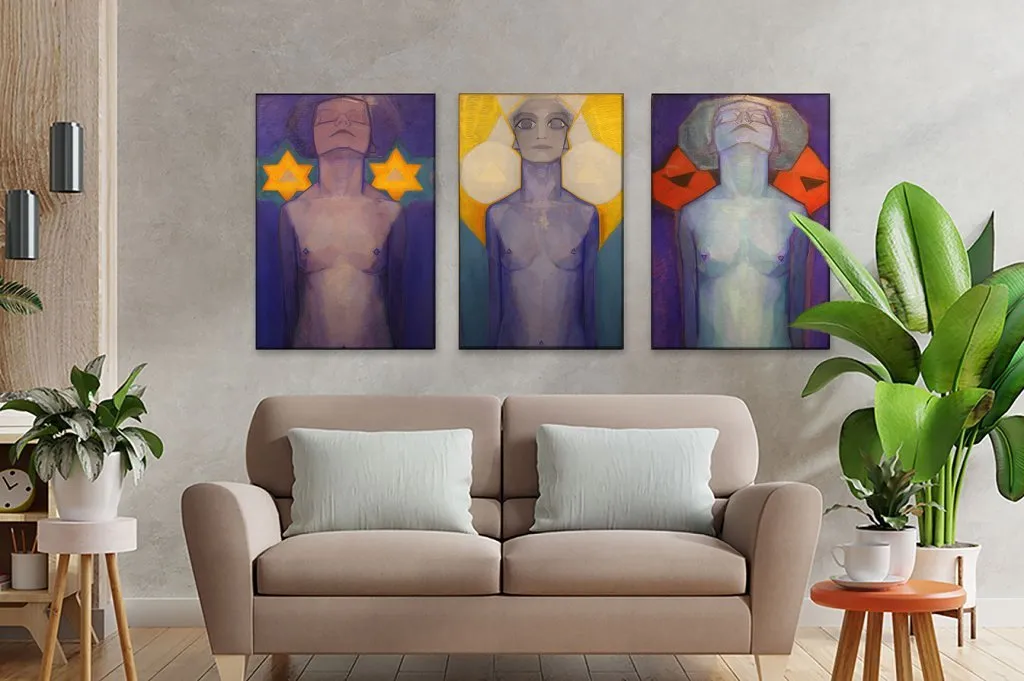 The Evolution by Piet Mondrian triptych has three panels, so number each one and pack them together so the set stays in order.
How do you pack a canvas or framed print step by step?
This method suits stretched canvas, framed prints and floating frames. It takes about ten minutes per piece once you are set up.
- Clean and prepare. Dust the surface gently with a clean dry cloth. Do not use liquids. If you need to wash anything, see our guide on how to clean canvas prints first, and let it dry fully.
- Check the hardware. Look at the D rings, wire and felt bumpers. Tuck the wire against the back so it cannot scratch another print. Our stretched canvases come with D rings, picture wire and felt corner bumpers, and the bumpers are useful to leave in place.
- Cover the face. Lay clean paper or a soft cloth over the front, covering the whole surface. For acrylic, use a soft cloth first, because paper can leave fine scratches if it slides.
- Protect the corners. Fit corner protectors on all four corners. Corners are the most common point of damage, so do not skip this.
- Add rigid cover. Place a sheet of cardboard on the front and another on the back, slightly larger than the print. Tape the cardboard edges together around the sides, taping only the cardboard.
- Add the outer layer. Wrap bubble wrap or foam around the whole package. Bubbles should face inward, but keep the paper layer between the bubbles and the print so the bubble pattern does not press into the surface.
- Box if possible. A picture box or a custom cut carton gives the best protection. Fill any gaps with soft padding so the print cannot move.
- Label clearly. Mark “Fragile”, “This way up” and the contents. For multi-panel sets, label the panels and the order.
- Photograph before sealing. A photo of the print, and of the packing, is helpful if you need to make a claim later.
Packing several prints together
You can group prints for a move, but only with care.
- Pack each print individually first, as above.
- Stand them upright on the long edge, in a tight row, with a sheet of cardboard between each one.
- Put the largest at the back and the smallest at the front, and strap them so they cannot slide.
- Do not stack prints flat with weight on top.
- Keep a set together, for example the three panels of a triptych, in one package or one clearly marked stack.
Moving house checklist
A move has many hands and many surprises. The checklist below puts the art in the right order, so it is protected before the rest of the chaos begins.
- Take down prints a few days before the move and pack them while the space is still calm. Our guide on how to hang canvas prints covers how to take them down cleanly.
- Measure each print and the doors, stairwells and lifts it must pass through.
- Pack and label every piece using the method above.
- Tell the removalist which boxes are art, and ask whether they will transport them upright and separate from heavy items.
- Ask whether the removalist’s insurance covers artwork, and what proof of value they need.
- For prized or large pieces, carry them yourself in your own car.
- Load prints upright, against a flat surface, wrapped in moving blankets and strapped in place.
- Place prints last on and first off the truck, so nothing is stacked on them.
- Check each piece on arrival, before signing off on delivery, and note any damage in writing.
- Unpack and hang or store them straight away, so they are not left in boxes in a hot or damp space.
Driving with art in your own car
If you are moving a few prints yourself, the cabin is the right place for them. A closed car in summer sun can get very hot inside, and a boot is not climate controlled. Here are the habits that help.
- Place the prints upright against the back seat, with the print facing the seat, padded with a blanket.
- Keep the air conditioning on in summer, and park in the shade if you must stop.
- Do not leave art in a parked car for long periods, particularly in summer.
- Do not stack heavy items on top of a print, and do not lay it flat on a seat under bags.
- Use a strap or seatbelt to hold large pieces still.
If you are lifting a large print, carry it with the face towards your body and the corners protected, and use two people for anything with a longest edge over about 120 cm. Large pieces can also act like a sail in the wind, so take care in car parks.
 The Aerial Archway canvas shows why upright storage on the long edge, with cardboard between pieces, protects both the face and the corners.
What are the best conditions for storing prints?
Storage is where most slow damage happens, because problems build up unseen. The aim is a place that stays cool, dry and stable. For background on what canvas is made of, see this overview of canvas prints.
Choose the right space
- Inside the living space is best: a wardrobe, a spare bedroom, under a bed (for small prints) or a cupboard against an internal wall.
- Garages and sheds are risky in Australia, because temperature and humidity swing widely. In humid regions, mould can develop in a few weeks.
- Self storage units can work, and a climate controlled unit is better than a standard one. Ask about humidity and ventilation, and avoid ground level units that flood.
- Avoid external walls, bathrooms, laundries and anywhere with a leaking roof.
Position the prints
- Stand them upright on the long edge, on something clean and raised, such as a timber batten or a pallet, to keep them off a damp floor.
- Use cardboard between each piece, and keep prints apart from other objects.
- Do not lean a print against a heavy object or under shelves. Pressure can warp stretcher bars.
- Keep the stack upright and slightly supported, not leaning at a steep angle.
- Wrap the stack in a breathable cover, such as a clean cotton sheet or acid free paper, not a sealed plastic bag.
Storage do and avoid table
| Do | Avoid | Why |
|---|---|---|
| Store upright on the long edge | Laying prints flat with items stacked on top | Weight on the face dents canvas and bends frames |
| Wrap in clean paper or cotton cloth | Plastic wrap or a sealed bag against the surface for long term storage | Plastic traps moisture and can mark the protective coating or acrylic |
| Keep in a cool, dry, stable space inside | Garages, sheds, car boots and loft spaces in summer | Heat and humidity swing widely and can cause warping or mould |
| Raise off the floor on battens | Direct contact with concrete or a damp floor | Floors can wick moisture and flood |
| Separate pieces with cardboard | Stacking canvases face to back with no layer between | Staples, wire and bars can press into the face of the next piece |
| Keep out of light | A spot where sun reaches the print, even through a window | Direct sunlight is not recommended for any print |
| Check every few months | Leaving art untouched for years | You catch humidity, mould or pests early |
 The Icelandic Waterfall print is a good reminder that moisture is the enemy: keep stored canvases away from damp floors and bathrooms.
How do Australian conditions change the advice?
Australia covers tropical, arid and temperate climates, and the risks vary by region.
- Tropical and subtropical coast: high humidity for much of the year. Prioritise ventilation and dry storage, and check regularly for mould.
- Hot inland regions: heat is the main concern. Avoid roof spaces, sheds and cars, and choose an insulated internal space.
- Temperate south: cooler, but damp winters can affect garages and subfloors. Keep prints off concrete.
- Summer everywhere: a closed car, shed or storage unit can reach temperatures far above the air outside. Never leave art in them for long.
Our guide to caring for your canvas prints offers more habits worth building, and our fading guide explains why direct sun is a concern.
Signs that storage is going wrong
- A musty smell around the prints.
- White or dark spots on the back of a canvas, the frame or the packaging.
- A sagging or rippling canvas surface.
- Sticky or tacky surface coating after a hot period.
- Condensation inside packaging.
If you see any of these, unwrap the print in a dry, ventilated place, let it dry gently away from direct heat and move it somewhere better. If you are not sure what you are seeing, photograph it and email the team at [email protected].
 Sunrise with Sea Monsters is a reminder to photograph each piece before packing, which makes any later claim far simpler.
How do you ship a canvas print or send one as a gift?
If you are sending a print through a courier, the principles are the same as for moving, with one extra rule: assume it will be handled roughly.
- Pack the print as described above, with corner protectors and cardboard on both faces.
- Choose a box that leaves padding on every side, and fill any gaps so the print cannot move.
- Do not tape the print to the box. Let it sit within padding.
- Mark the box “Fragile” and “This way up”, and add the delivery address inside the box too.
- Photograph the packed box and the print before sealing.
- Use a tracked service, and consider insurance for valuable pieces.
- Ask the receiver to open it promptly and photograph any damage.
For comparison, our canvases are wrapped in protective film and boxed, and rolled canvas and paper prints go in a sturdy tube. You can read how we do it in how canvas prints are shipped and packed in Australia, and our shipping prices and times page lists courier times by region. Shipping size bands run from Small up to 60 cm to X-Large 121 to 152 cm on the longest edge, which is useful when choosing a box.
If the print arrives damaged
If a print you ordered from us arrives damaged, faulty or incorrect, email [email protected] with your order number and photos within 30 days of delivery. We replace or refund in full, cover return postage and charge no fees, in line with the ACCC consumer guarantees. See our returns and refunds policy. Damage caused by your own move or storage is a separate matter, which is why careful packing matters.
What should you do when you unpack?
- Let it acclimatise. If a print has been in a hot or cold vehicle, leave it wrapped at room temperature for a few hours before opening.
- Unwrap carefully. Cut the tape, never the packaging near the print. Remove the cardboard and the paper layer.
- Inspect. Check the corners, the stretcher bars, the surface and the back. Look at the acrylic for scratches and at the canvas for dents.
- Check the hardware. Confirm the D rings and wire are secure before hanging.
- Hang or store properly. Hang it where it is out of direct sun. Our ultimate guide to hanging art helps with placement, and the article on reducing glare and lighting art helps you choose the spot.
- Keep the packaging for a while in case you need to move again soon.
If a canvas is slightly slack after a damp period, let it dry in a stable, dry space before judging. If it stays slack or a dent remains, contact the team for advice, and do not try to fix it with heat or water.
If you are moving to a rental
A rental can mean fewer fixing options, so plan how you will hang the art before the move. Read our guide on hanging art in a rental for no-damage methods.
Mistakes that cause most damage
- Leaving art in a hot car. A parked car in summer is one of the harshest places for a print.
- Stacking prints flat. Weight on the face dents canvas and can crack frames.
- Skipping corner protection. Corners take the knocks, and are the most common damage.
- Using plastic against the surface for long storage. It traps moisture and can mark the finish.
- Storing in a damp garage or shed. Mould and warping follow quickly in humid regions.
- Taping the artwork. Tape on canvas, frame or acrylic can leave residue or lift finish. Tape the packaging only.
- Not labelling. Unlabelled boxes get stacked wrongly or opened with a knife.
- Forgetting to photograph. A before photo makes any claim far easier.
Frequently asked questions
Can I store canvas prints flat?
You can for a short time if nothing is on top, but upright on the long edge is better. A flat stack puts weight on the faces and can dent canvas or bend stretcher bars. If you must store flat, use a single layer on a clean, flat surface with cardboard under and over.
How should I wrap a canvas for moving?
Cover the face with clean paper or soft cloth, fit corner protectors, add cardboard on both sides and wrap the package in bubble wrap or foam. Tape only the packaging, not the canvas. Stand it upright and label it fragile.
Is it safe to store canvas prints in a garage?
It is risky in many parts of Australia, because garages swing in temperature and humidity and can be damp. If you must use one, raise the prints off the floor, keep them off external walls, wrap them in breathable cloth and check them often.
Can I leave a canvas print in a hot car?
No. A closed car in summer can become far hotter than the air outside, and heat can stress timber, glue and the protective coating. Carry prints in the cabin with the air conditioning on, and do not leave them in a parked car for long.
What is the best way to protect framed prints with acrylic?
Protect the corners, cover the clear acrylic with soft cloth or paper and add rigid cardboard on both sides. Avoid tape on the acrylic, because adhesive can mark it, and use a soft cloth for cleaning rather than a rough one.
Should I use plastic wrap or bubble wrap on a canvas?
Use bubble wrap only as an outer layer, over a layer of clean paper or cloth. Plastic directly against the surface for a long time can trap moisture and mark the finish. For long term storage, use breathable wrapping.
How do I transport a large canvas in a car?
Stand it upright against the back seat or in a hatch, wrapped in a blanket and held in place with a strap or seatbelt. Keep the face towards a flat surface, and do not stack other items on it. Check that it does not touch hot or sharp surfaces.
Can I fold a canvas print to pack it?
No, folding creates creases that can crack the ink. A stretched canvas cannot be folded, and an unstretched canvas should be rolled loosely with the print facing out. Use a sturdy tube for rolled canvas.
How long can I store a print before it is a problem?
In a cool, dry, stable space, a well wrapped print can be stored for a long time. Problems depend on conditions rather than time, so check stored art every few months for smells, spots and sagging.
What if my print is damaged after a move?
Photograph the damage and the packaging, and contact the removalist or insurer if they handled it. For a print that arrived damaged from us, email the team within 30 days of delivery. For advice on repairs, email [email protected].
Keeping your art safe on the move and in storage
Protect corners, keep faces free from pressure, stand prints upright and choose cool, dry, shaded spaces. Do those four things and your art will arrive and keep in the same condition you packed it.
When you are ready to hang again, browse our canvas prints, the triptych wall art canvas collection or the office art range. For help with a specific piece, call 1300 632 332 or email [email protected], and see the FAQ for more answers. Examples such as the Evolution by Piet Mondrian triptych and the Icelandic Waterfall print pack down well when you follow the steps above.
Browse every guide in our series on the canvas print guides page.
