


A star map is the easiest personalised gift to get slightly wrong, and the mistakes are nearly all small ones: a date typed the American way round, a time given in the wrong time zone, a hospital named when the suburb was meant. None of it is hard. It just helps to know what the design needs before you open the product page.
This guide explains exactly what a personalised star map shows, which details you must supply (date, time and location), what to do when you do not know the time, how precise the location needs to be, and how our proof process catches mistakes before anything is printed. There is a checklist table and a step by step ordering method near the end, so you can gather everything in one go.
Short answer: A personalised star map shows the night sky as seen from one place at one moment, so you supply the date, the time and the location, plus any text you want. An approximate time is usually fine. A digital proof is sent for approval before printing, usually within 2 business days, and changes to layout, wording or colour are free.
Key takeaways
- Date, time and location are required on star map orders, so collect them before you start.
- The sky turns about 15 degrees every hour, so a time that is out by a few minutes rarely changes the look noticeably, though larger gaps will.
- If you do not know a time, look for a birth certificate, hospital record, photo timestamp or event schedule.
- Use the local clock time at the place, and check the day and month order before you submit.
- You approve a digital proof before printing, and corrections to layout, wording or colour cost nothing.
What does a personalised star map actually show?
A star map is a picture of the night sky above a particular place at a particular moment. If you stood at that location at that exact time and looked up, the stars and constellations arranged on the design are the ones you would have been able to see, assuming a clear sky and no light pollution. That is why it makes such a good keepsake for a wedding, a birth, a first date or a place that matters.
It is a piece of artwork rather than a navigation tool. Our existing guide, what star maps actually show (and what they don’t), explains the limits in detail, and we repeat the key points near the end of this article. For ordering purposes, what matters is that three inputs decide the sky: the date, the time of day, and the place on Earth.
The rest of the design, the title, the names, the message, the layout and the colours, is what you personalise on top. You can browse the full range in the personalised star maps category.
What information do you need before you start?
Gather these details first and the order itself takes a few minutes. The site requires the date, time and location on star map orders, and the other fields depend on the design you choose, so read the options on the product page.
| Detail | Required? | What to enter | Common slip to avoid |
|---|---|---|---|
| Date | Yes | The day, month and year of the moment | Swapping day and month, for example 4 March typed as 3 April |
| Time | Yes | Local clock time at the place, ideally to the nearest 5 to 15 minutes | Giving the time in your own time zone instead of the place’s |
| Location | Yes | City or suburb, or a full street address if you want precision | Using a hospital name when only the town is recognised by the form |
| Title and text | Per design | Names, a short message, the date in words, coordinates | Long text that crowds the design |
| Photo | Only on photo designs | A clear, high resolution image | A tiny screenshot saved from social media |
| Size and format | Yes | One of the sizes on the product page | Choosing a size that does not fit the frame or space |
| Colour or style | Per design | Pick from the options shown | Choosing dark ink on a dark background |
Keep a note on your phone with the date written out in full, the time with am or pm, and the exact place name. You will use all three more than once.
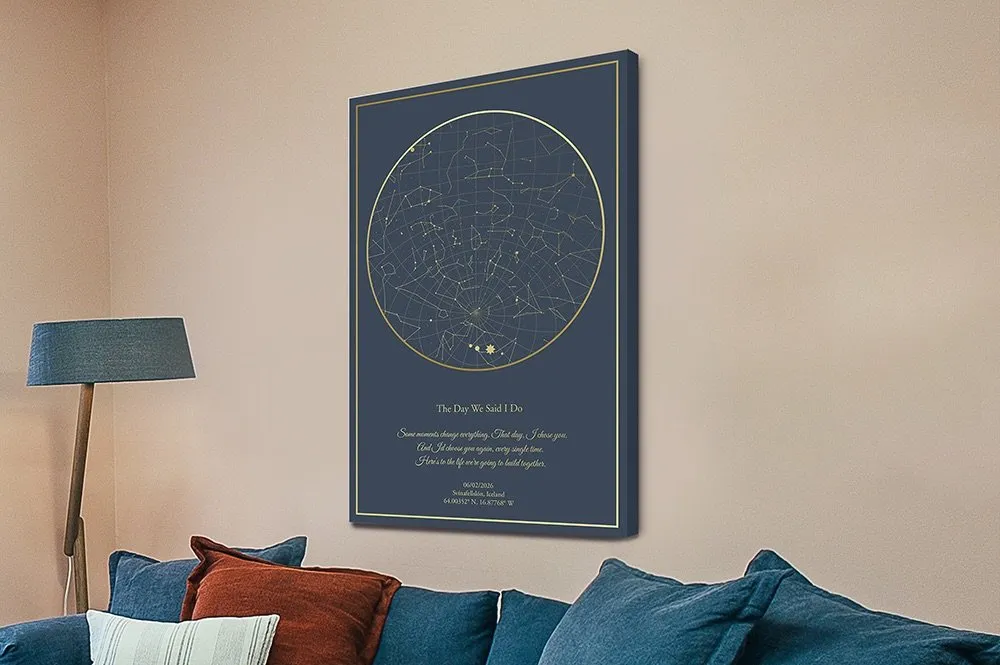 The Day We Said I Do Personalised Star Map Canvas turns a wedding date, time and place into a single display piece.
How should you enter the date?
Type the date exactly as it appears on the document you are copying it from, and then read it back in words. “04/03/2021” is 4 March in Australia and 3 April in the United States, so a date copied from an overseas record can quietly flip. Writing “4 March 2021” in your notes removes the ambiguity.
Two situations deserve extra care:
- Events near midnight. If something happened at 12.20am on the 9th, the calendar date is the 9th even though the evening before felt like the same night. Enter the actual calendar date and time shown on the record.
- Different time zones. If a birth was registered in another country, use the local date at the place of birth, which may differ from the date back in Australia.
Why does the time matter, and how accurate does it need to be?
The sky appears to rotate once about every 24 hours, which works out to roughly 15 degrees an hour, or about 1 degree every 4 minutes. That is the whole reason a time is needed: the same place on the same date looks different at 8pm and at 2am, because different constellations are overhead.
The practical consequence is encouraging. A time that is out by 5 or 10 minutes moves the stars by only a couple of degrees, which is difficult to see on a printed chart. An error of an hour moves everything by around 15 degrees, which is visible if you compare the two layouts side by side. As a rule of thumb, aim for the nearest 15 minutes, and treat anything within half an hour as a reasonable approximation. These are general astronomical relationships rather than guarantees about any individual artwork, so if the exact moment is the point of the gift, find the exact time.
Use local clock time and watch daylight saving
Enter the time as it was on the clock at the place, not converted to your own time zone. If the event happened during daylight saving, use the time people actually saw on their watches that day, which is what a birth record or wedding schedule will show. Note that Queensland, Western Australia and the Northern Territory do not observe daylight saving, while New South Wales, Victoria, South Australia, Tasmania and the ACT do, so a date in summer can matter for Sydney but not for Brisbane. If you are unsure how the form treats daylight saving, mention it in your order notes and the team can check it with you at proof stage.
How do you find the time if you do not know it?
This is the most common sticking point, especially for gifts about a first meeting or an old family event. Work through these sources in roughly this order, from most to least reliable.
- Birth certificate or birth announcement. Many certificates and hospital wristbands record the time of birth. Hospital discharge summaries and baby books often do as well.
- Wedding or event schedule. The ceremony start time is on the invitation or the run sheet from the venue or celebrant. Choose the moment that matters most, usually the vows or the first dance.
- Photo and video timestamps. Most phones record the capture time in the file details. A photo of the moment, even one taken minutes later, narrows it to within a few minutes.
- Messages and emails. A text that says “just landed” or “we are engaged” has a timestamp. Booking confirmations and dinner reservations do too.
- Relatives’ memories. Ask more than one person and see if the answers cluster. “Just after lunch” is enough to pick 1.30pm.
- A deliberate choice. If no record exists, choose a meaningful time such as the ceremony time, midnight, or sunrise, and say so in the message line if you want. A star map is a keepsake, not an official record.
When you truly cannot find the time, an approximation labelled honestly works better than a precise-looking guess. If someone will later compare the chart with a record, they will thank you for choosing the real time, even if it took an extra day of asking.
How precise should the location be?
Location sets the horizon and the latitude, which decide which constellations can be seen and how high they sit. The good news is that the sky changes slowly as you move around. A move of a few kilometres makes no visible difference, so a suburb or city is accurate enough for almost every order. A full street address is available if you want it, particularly when the place has meaning, such as a venue or a family property.
Here is a practical guide:
| Situation | Suggested location entry | Why |
|---|---|---|
| Birth in a major hospital | The suburb or city of the hospital | Differences within a city are too small to show |
| Wedding at a named venue | The venue town or the venue address | The address also gives you a printable place name |
| First meeting in a place that no longer exists | The nearest suburb or street | The sky is the same for the surrounding area |
| A holiday or remote location | The nearest town, or the lookout or beach name | Remote places may not be found by the form, so use the closest named point |
| An overseas location | City and country | Prevents confusion between places with the same name |
Latitude matters more than longitude here. A star map made for Cairns and one for Hobart will look very different because the two cities are about 25 degrees of latitude apart, whereas Sydney and Newcastle look almost the same. If your location has a common name, such as a town that exists in more than one state, include the state to avoid the wrong one being picked. When in doubt, send a message to the team before you pay and they will confirm it on the proof.
What text can you add to a star map?
Text is where the gift gets its personality. Most star map designs offer space for a title, a line of names and a short message, and some add the date, place and coordinates in small print. Check each product page for the exact fields, because layouts differ by design.
Keep it short and readable
Short lines read best. A title of two to five words, one line of names and a brief message give the design space. If your message is longer than about 120 characters, consider cutting it. Printed text on a night-sky background is easy to read at normal viewing distance but less so when it gets small.
Ideas that work
- The date in words, such as “Fourth of March, 2021”.
- Names with a short phrase: “Our first night together”.
- A place and a time: “Noosa, 9.42pm”.
- A line of a song or poem you both know.
- A family motto or a child’s full name and birth weight.
If you want a bank of phrasing ideas, starry words: text ideas to personalise your star map gift has plenty. Our word art on canvas range is also worth a look if you want a text-only piece to sit alongside.
 Our Night Sky Our Story Wedding Vows Star Map Canvas leaves space for a short vow or message beside the chart.
Can you add a photo to a star map?
Some designs combine the chart with a photograph, such as the Under Our Stars personalised star map canvas with photo, or A Moment Written in the Stars. These are designs where you upload an image and the layout places it alongside the chart. Not every star map has a photo option, so look for it in the product title or description.
If you are adding a photo, follow the same rules as any photo print: pick a sharp image, as large as the original file allows, and avoid screenshots or heavily compressed copies. Our photo upload guide shows the upload steps, and photo resolution for canvas prints by size explains how many pixels a given size needs (the idea is pixel density). You can also try the free photo resolution checker before you order. A photo with the subject near the edge may be cropped by the layout, so choose an image with some breathing space around the faces.
What happens after you order? The proof process
Star maps are personalised artwork, so nothing is printed until you approve it. Here is the sequence:
- You place the order with your date, time, location, text and any photo.
- The team prepares a digital proof of your design and sends it to you, usually within 2 business days.
- You check it carefully against your notes. Look at the date, the time, the spelling of names and the place name.
- If anything needs changing, reply with what to fix. Changes to layout, wording or colour are free.
- When you approve it, printing starts. Printing starts only after approval.
Check the proof the way a proofreader would: read every word aloud, then compare the date and time with your notes. If something is off, say so. It is much easier to fix at proof stage than after printing, and because each item is made to order, it cannot be returned for change of mind. Damaged, faulty or incorrect items are a different matter and are replaced or refunded, which is covered at the end of this article.
Which format and size should you choose?
Star maps are offered on stretched canvas and in other formats on certain designs, so check the product page for what is offered. Canvas is the most popular choice for personalised pieces. It arrives ready to hang, on a 1.5 inch (38mm) thick kiln-dried pine stretcher frame, with D rings and wire fitted. Wrap options at the same price are mirror wrap, gallery wrap (more of the image wraps the timber) and a coloured border in black or white. See the wrap options page for what each looks like, and think about the border or wrap before you finalise text placement, because a gallery wrap uses up some of the image edge.
| Where it will hang | Typical size | Notes |
|---|---|---|
| Desk, shelf or bedside | Small, 12 x 16 in (31 x 41 cm) or 12 x 18 in (31 x 46 cm) | Good for a nursery shelf or a small gift |
| Bedroom or hallway | Medium, 18 x 24 in (46 x 61 cm) or 18 x 27 in (46 x 69 cm) | Detailed text stays readable |
| Above a bed or sofa | Large, 24 x 32 in (61 x 81 cm) or 24 x 36 in (61 x 91 cm) | The best balance for a main display |
Star maps are often square or in a specific ratio. Exact sizes are shown on the product page, so use that list rather than this table when you finalise. For all the ladders, see the canvas print size chart for Australia. If you plan to frame a paper version, choose a frame colour that suits the dark background of the chart, and note that a lighter frame colour is typically the softer option against a navy field.
What is a star map not?
It helps to be clear about what you are buying, so the gift lands the way you intend.
- It is not a navigation chart. It is an artistic rendering, and it will not replace a planetarium app if you are learning the sky.
- It is not a record of what was actually visible. Clouds, city lights and the horizon were different on the night. The chart shows what the sky held, not what a camera captured.
- It is not an exact reproduction of every faint star. Charts show the brighter stars and the constellation patterns. If you need every star, a dedicated astronomy product is a better fit.
Our post on what star maps show goes further. The point is that the gift’s strength is the meaning, not the astronomical detail.
 The Personalised Zodiac Star Map Canvas suits birthdays, where the chart and the zodiac sign both carry meaning.
What is the step by step method for ordering?
Use this sequence and you will avoid nearly every common error.
- Write down the three required details: the date in words, the local time with am or pm, and the place name with its state or country.
- Verify the time against a record, or choose a meaningful time on purpose.
- Choose the design from the star map category, for example a wedding design such as Our Night Sky Our Story Wedding Vows or a milestone design.
- Draft the text in a notes app first, and count the characters against the fields shown.
- Prepare a photo if the design has one, and check its resolution.
- Select size and wrap, checking the product page for the sizes offered.
- Place the order and watch your inbox for the digital proof, usually within 2 business days.
- Proof it: date, time, place, names, spelling.
- Approve or request changes. Printing starts only after approval.
How long will it take, and how do you plan a gift?
Production is typically 3 to 4 business days after approval, with courier time on top. Because the proof comes first, build in the proof round when planning around a date. Work backwards from the day you need it:
- Courier time by region (for example Brisbane 2 to 3 business days, Sydney and Melbourne 3 to 5, Tasmania and NT 8 to 14).
- Production, 3 to 4 business days.
- Proof turnaround, usually within 2 business days, plus your own reply time.
- A few spare days, since peak periods can add days.
For a wedding, anniversary or birth announcement, allow at least two to three weeks end to end. Our posts on how canvas prints are shipped and packed and last-minute canvas print gifts cover the schedule in detail, and the shipping prices page has the rates. If the gift is a photo-led piece, you might also like the ideas in how to plan a photo collage canvas, which pairs well with a star map as a matched set.
Frequently asked questions
Do I have to know the exact time to order a star map?
You need to enter a time, but it does not have to be exact to the minute. The sky shifts only about 1 degree every 4 minutes, so a time within roughly 15 minutes looks very close. If you only know the part of the day, choose a sensible midpoint.
What if I do not know the time of birth?
Check the birth certificate, hospital paperwork or baby book first, then ask relatives or look at photo timestamps. If nothing is available, pick a meaningful time deliberately rather than guessing at random.
Should I use my local time or the time at the place?
Use the local clock time at the place the event happened. If a baby was born in Perth, enter the Perth time even if you live in Sydney.
Does the location need to be a street address?
No. A suburb or city is accurate enough for the sky itself, because a few kilometres makes no visible difference. A street address is useful when the place has sentimental meaning and you want it shown.
Can I change the star map after I see the proof?
Yes. Changes to layout, wording or colour are free, and printing starts only after you approve. If you change the date, time or location, the chart itself is redrawn, so check the new version carefully.
How long is the proof stage?
The digital proof is usually sent within 2 business days of your order. After that, the timing depends on how quickly you reply and approve.
Can I add a photo to my star map?
Some designs include a photo option, and these are marked on the product page. Upload a sharp, high resolution image, and see the photo upload guide for the steps.
Is a star map scientifically accurate?
It is based on the real sky for the date, time and place you provide, but it is an artwork, not a navigation chart. Brighter stars and constellation patterns are shown rather than every faint star.
Can I return a star map if I change my mind?
No, because every item is made to order and personalised items are proofed before printing. If an item arrives damaged, faulty or incorrect, it is replaced or refunded in full when you claim within 30 days of delivery.
What size is best for a star map?
For a main display above a bed or sofa, Large is usually the best balance, while Small suits a shelf or desk. Check the product page for the exact sizes offered on your design.
Ordering your personalised star map
Collect the date, time and place, confirm the time from a record where you can, and keep your text short. Then use the proof round properly: it is there to catch the day and month swap or the wrong state before anything is printed. For a first-time buyer, a canvas in Large size with a gallery wrap is a safe, popular choice.
When you are ready, browse the personalised star maps or see The Day We Said I Do for a wedding example. If you are stuck on the time or location, call 1300 632 332 or email [email protected], Monday to Friday 8.30am to 4.15pm local time, and the team will help before you order. Faulty or incorrect goods are also covered by the Australian Consumer Law consumer guarantees.
Browse every guide in our series on the canvas print guides page.
