


You have a tape measure in one hand and a product page in the other, and the numbers do not line up. Australians measure in centimetres, canvas sizes are traditionally quoted in inches, and many people think in A4 and A3 paper. This page puts all three side by side so you can translate a size in seconds.
Below you will find a complete chart of our standard sizes, the logic behind the two size ladders, a clear paper size comparison, the pixels your photo needs, and a step by step method for choosing a size for a real space. Everything is based on the sizes we actually produce.
Short answer: Our standard canvas sizes follow two ladders. The 2:3 ladder runs 12 x 18, 18 x 27, 24 x 36, 30 x 45 and 40 x 60 inches (31 x 46 cm up to 102 x 152 cm). The 3:4 ladder runs 12 x 16 up to 36 x 48 inches (31 x 41 cm up to 91 x 122 cm). Pick the ladder that matches your image shape.
Key takeaways
- Every size within a ladder has the same shape, so artwork is scaled, never stretched or cropped.
- Inches convert at 2.54 cm per inch; our chart rounds to the nearest centimetre.
- A-series paper is a different ratio from canvas, so any comparison is approximate.
- Art should be about two thirds to three quarters the width of the furniture below it, and the most common regret is going too small.
- A floating frame adds to the outer size on every side, so check the outer dimensions on the product page.
How canvas print sizes work
A canvas size is simply the width and height of the printed image area, usually listed in inches in the print industry and shown here in both units. At Canvas Prints Australia the standard sizes are grouped into ladders, which are sets of sizes that all share one aspect ratio. A ratio is the relationship between the two sides, such as 2:3, and you can read more about it in this general explanation of aspect ratio.
Sizes within a ladder are true scale versions of each other. Your artwork or photograph is scaled up or down, never stretched or cropped to fit. That is the main reason we use ladders. If you move from Large to X-Large, the picture is identical, only bigger.
Some artworks also come in square, panoramic or multi panel formats. Their exact sizes are shown on each product page, and we cover them below.
Quick inch to centimetre conversion
Multiply inches by 2.54 for centimetres, or divide centimetres by 2.54 for inches. As a shortcut, 12 inches is about 30.5 cm, 24 inches is about 61 cm, and 36 inches is about 91.5 cm. We round to the nearest whole centimetre in the charts, so a 12 inch edge appears as 31 cm and a 30 inch edge as 76 cm. If you are checking a measurement against a frame or a gap, always use the figure from the product page and measure with a tape, not by eye.
The full size chart: 2:3 ladder
The classic 2:3 ladder suits most DSLR and mirrorless camera photos, a large share of painting reproductions and many posters. Each size is shown portrait; turn it sideways for landscape.
| Size name | Inches | Centimetres | Approximate paper equivalent | Shipping band by longest edge |
|---|---|---|---|---|
| Small | 12 x 18 | 31 x 46 | A little larger than A3 | Small (up to 60 cm) |
| Medium | 18 x 27 | 46 x 69 | Between A2 and A1 | Medium (61 to 90 cm) |
| Large | 24 x 36 | 61 x 91 | A little larger than A1 | Large (91 to 120 cm) |
| X-Large | 30 x 45 | 76 x 114 | Slightly smaller than A0 | Large (91 to 120 cm) |
| XX-Large | 40 x 60 | 102 x 152 | Larger than A0 | X-Large (121 to 152 cm) |
The paper column is approximate. A-series sheets use a different shape (about 1:1.41), so no canvas matches any A size exactly. Use the column as a feel for scale, not as a precise match.
The full size chart: 3:4 ladder
The 3:4 ladder suits phone photos, many compact camera images and portraits, because their native shape is close to 3:4 or 4:3.
| Size name | Inches | Centimetres | Approximate paper equivalent | Shipping band by longest edge |
|---|---|---|---|---|
| Small | 12 x 16 | 31 x 41 | Close to A3 | Small (up to 60 cm) |
| Medium | 18 x 24 | 46 x 61 | A little larger than A2 | Medium (61 to 90 cm) |
| Large | 24 x 32 | 61 x 81 | A little larger than A1 | Medium (61 to 90 cm) |
| X-Large | 30 x 40 | 76 x 102 | Between A1 and A0 | Large (91 to 120 cm) |
| XX-Large | 36 x 48 | 91 x 122 | About A0 or a little larger | X-Large (121 to 152 cm) |
Shipping bands are indicative and based on the longest edge in centimetres. Shipping is one fee per order based on the largest shipping size in the order, and the current rates are on the shipping prices page. For item prices use the Size and Price Guide.
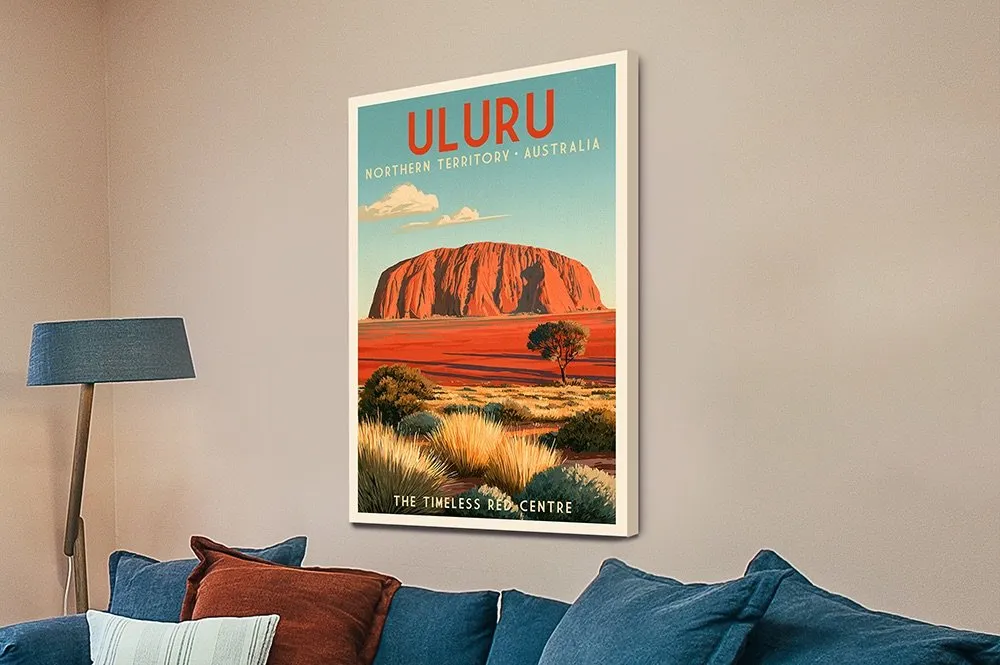 A 2:3 poster style design such as Uluru Travel Poster scales up the classic ladder without any cropping, from Small to XX-Large.
A-series paper compared with canvas sizes
People often ask for an A3 or A1 canvas because that is the unit they know. A-series paper starts with A0, which has an area of one square metre, and each step down halves the sheet. The dimensions are standard.
| Paper size | Millimetres | Centimetres | Closest canvas size, approximate |
|---|---|---|---|
| A4 | 210 x 297 | 21 x 29.7 | Smaller than our Small, ask about custom sizes |
| A3 | 297 x 420 | 29.7 x 42 | 12 x 16 or 12 x 18 in |
| A2 | 420 x 594 | 42 x 59.4 | 18 x 24 in |
| A1 | 594 x 841 | 59.4 x 84.1 | 24 x 32 or 24 x 36 in |
| A0 | 841 x 1189 | 84.1 x 118.9 | 30 x 45 or 36 x 48 in |
What to do if you need an exact paper size
Because A-series is a different ratio, a canvas that matches A1 exactly would not be one of our scaled ladder sizes. If you have a frame or space that needs an exact measurement, contact us. Custom sizes are available by request up to 140 cm on the shortest edge. If you are matching a ready made frame for a paper print, the Borders, Mounts and Framing guide explains how borders change the fit.
Square, panoramic and multi panel formats
Square
Square canvases work well for dining areas and symmetrical arrangements, and they avoid the portrait or landscape decision. Because they do not belong to either ladder, exact sizes are on each product page.
Panoramic
Panoramic prints are long and narrow, for example a 3:1 ratio such as 30 x 10 inches (about 76 x 25 cm). They suit above a bed, a hallway or a long sideboard. Our dedicated panoramic canvas prints guide covers shapes and subjects, and the panoramic photography category shows what is available. For the format’s background see panoramic photography on Wikipedia.
Multi panel sets
Triptychs and other sets are measured as an overall footprint, with gaps between panels. A triptych (three panels) is a common choice for a long space above a sofa. The post on triptych, diptych and five panel canvases explains how to pick a layout, and you can browse triptych wall art canvas for examples such as Evolution by Piet Mondrian.
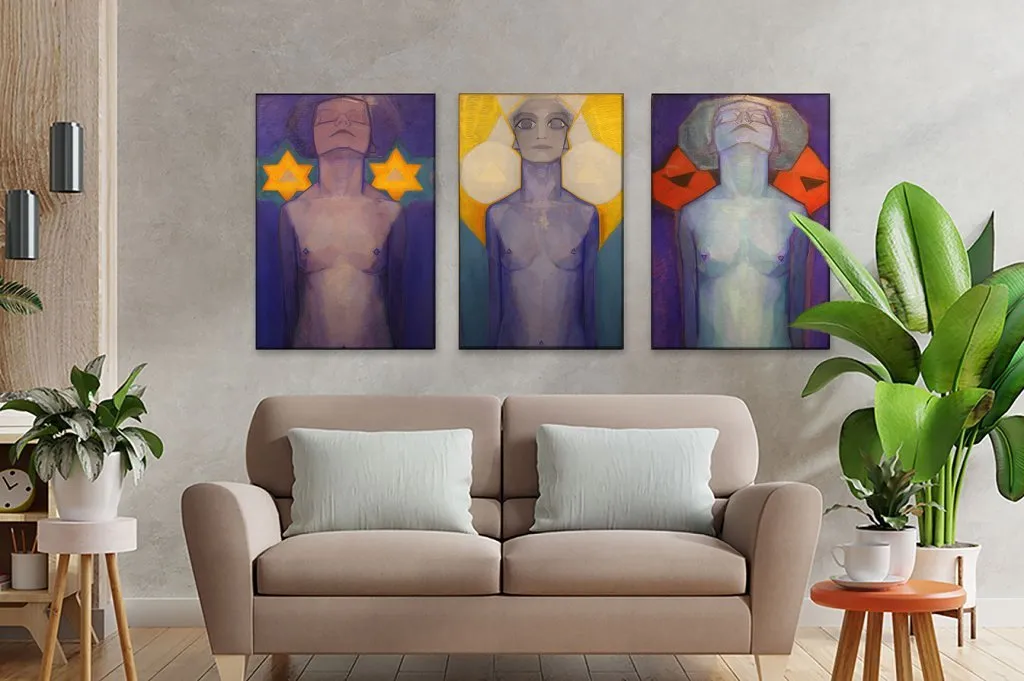 Multi panel sets such as Evolution by Piet Mondrian are measured by their overall footprint, including the small gaps between panels.
How many pixels does each size need?
Size and file resolution are linked. A larger print needs more pixels to look sharp at the same viewing distance. The figure below uses 150 pixels per inch as a practical rule of thumb for good quality. It is a guideline, not a hard rule, because viewing distance and subject matter change what looks acceptable. For the concept, see this reference on pixel density.
| Ladder and size | Pixels at 150 per inch | Approximate megapixels |
|---|---|---|
| 2:3 Small 12 x 18 | 1800 x 2700 | 4.9 |
| 2:3 Medium 18 x 27 | 2700 x 4050 | 10.9 |
| 2:3 Large 24 x 36 | 3600 x 5400 | 19.4 |
| 2:3 X-Large 30 x 45 | 4500 x 6750 | 30.4 |
| 2:3 XX-Large 40 x 60 | 6000 x 9000 | 54 |
| 3:4 Small 12 x 16 | 1800 x 2400 | 4.3 |
| 3:4 Medium 18 x 24 | 2700 x 3600 | 9.7 |
| 3:4 Large 24 x 32 | 3600 x 4800 | 17.3 |
| 3:4 X-Large 30 x 40 | 4500 x 6000 | 27 |
| 3:4 XX-Large 36 x 48 | 5400 x 7200 | 38.9 |
Do not worry if your photo is below these numbers. Many good prints are made from smaller files, because big canvases are seen from a distance. The fastest way to find out is the Free Photo Resolution Checker, and our post on photo resolution for canvas prints by size goes into more depth. We also review uncertain images free before printing.
What size for what space
The size that looks right depends on what is below it, how far you stand away and how much attention you want the piece to get. This table starts from our own sizing guidance and turns it into a quick lookup.
| Space | Recommended size | Notes |
|---|---|---|
| Above a sofa or bed | Large to X-Large | Large 24 x 36 is our most popular size |
| Living space feature | X-Large or XX-Large, or multi panel | Use a set for very wide spaces |
| Bedroom | Medium to Large | Choose a calm image |
| Hallway | A run of Smalls, or a panoramic | Keep a steady spacing |
| Dining | Large or square | Align to the table width |
| Office | Small to Medium | Check the sight line from your desk |
The two thirds to three quarters rule
Art should be about two thirds to three quarters of the width of the furniture below it. That is a proportion that looks deliberate. Below, a worked table converts that into centimetres, assuming a landscape orientation where useful.
| Furniture width | Target art width | Sizes that fit well |
|---|---|---|
| 120 cm sideboard | 80 to 90 cm | 24 x 36 in landscape (91 cm), or a 3:1 panoramic |
| 150 cm two seater or queen bed | 100 to 112 cm | 30 x 40 in (102 cm) or 30 x 45 in (114 cm) landscape |
| 180 cm sofa | 120 to 135 cm | 36 x 48 in landscape (122 cm) or a three panel set |
| 220 cm sofa | 145 to 165 cm | 40 x 60 in landscape (152 cm) or a wide set |
For a 1.8 m sofa that means roughly 1.2 to 1.35 m of art. You can reach that with one large piece or with several smaller pieces spaced evenly, where the whole group counts as one width. The article on above sofa canvas art sizing shows 17 layouts, and how to choose the right size canvas print for your space adds more examples.
Height, gaps and spacing
- Centre height: hang so the centre of the print sits about 145 cm from the floor, which is a common gallery eye level.
- Above furniture: leave a gap of 15 to 25 cm between the top of the furniture and the bottom of the art.
- Groups and gallery arrangements: keep gaps of 5 to 7 cm between pieces.
Here is a worked example. A sofa back is 90 cm high and you are hanging a 24 x 36 inch print in landscape, which is 61 cm tall. Leave a 20 cm gap, so the bottom edge sits at 110 cm. The centre is then at 110 plus 30.5, which is about 140 cm, very close to the 145 cm target. If your sofa is lower, aim for the 145 cm centre and let the gap grow within reason.
Frames, wraps and how they change the outer size
Canvas size is the image size. A frame changes the outer size.
| Format | Effect on outer dimensions |
|---|---|
| Stretched canvas | Outer size is the listed size; depth is 1.5 inch (38mm) |
| Floating frame | Adds to the outer size on every side; confirm the outer size on the product page |
| Framed print | The frame adds to the print size; confirm the outer size on the product page |
| Rolled canvas or paper | Listed size only; add your own frame |
A floating frame canvas is larger overall than its listed size, which matters when you are fitting between a window and a doorway. For borders and printed margins on framed prints, see the framing guide. The gallery wrap carries part of the image around the timber, so keep key detail away from the very edge of your picture.
A step by step method to choose your size
- Measure the furniture or the gap. Use centimetres and write down the width and the available height.
- Work out the target width. Multiply the furniture width by 0.67 and by 0.75 to get your range.
- Choose the ladder. If the image is a DSLR photo, a painting or a poster, start with 2:3. If it is a phone photo or a portrait, start with 3:4. See the crop photo for canvas aspect ratio guide for how to check your image.
- Pick the size inside the range. Use the charts above and check the orientation you need.
- Make a paper template. Tape sheets of paper or newspaper to the surface at the real size, step back about two metres and look at it.
- Check the file. Use the resolution checker for the size you picked.
- Add the frame allowance. If you want a floating frame, allow extra on each dimension and confirm the outer size on the product page.
- Decide, and go one size up if torn. Going too small is the most common regret.
Aspect ratio tips that save a reorder
- A 2:3 photo shown on a 3:4 ladder will be cropped. We scale and never stretch, so if you need the whole image shown, pick the matching ladder.
- Check your photo’s pixel dimensions: divide the long side by the short side. About 1.5 means 2:3, and about 1.33 means 3:4.
- Leave breathing room around faces and horizons if you plan a gallery wrap.
- For movie poster shapes and standard poster dimensions, see how big movie posters are.
- For very large pieces, remember the 40 x 60 inch (102 x 152 cm) size is the largest standard 2:3 size, and 36 x 48 inches (91 x 122 cm) is the largest standard 3:4 size. Custom sizes go up to 140 cm on the shortest edge by request. See how big can you go.
 A skyline such as Sydney Two-Tone Skyline suits a landscape orientation, which is where the width charts above are most useful.
Common sizing mistakes and how to avoid them
| Mistake | What happens | Fix |
|---|---|---|
| Choosing from an A-series name | The canvas looks a different shape from the paper | Use the ladder chart, not paper names |
| Ignoring orientation | Width and height swap | Check whether you need portrait or landscape |
| Measuring the frame, not the image | Floating frames add to the outer size | Add the frame allowance |
| Going too small | The piece looks lost | Aim for two thirds to three quarters of the furniture width |
| Forgetting the file | Pixelation at large sizes | Run the resolution check first |
| Ignoring delivery size | A big piece does not fit a stairwell | Check delivery access and band |
Frequently asked questions
What is the most popular canvas print size?
Large 24 x 36 inches (61 x 91 cm) is our most popular size above a sofa or bed. It is large enough to anchor the space and small enough to handle easily. Many people move up to X-Large when they measure.
How big is a 24 x 36 canvas in centimetres?
It is 61 x 91 cm. That is slightly larger than an A1 sheet. With a floating frame, the outer size grows, so check the outer dimensions on the product page.
What canvas size is closest to A3?
Our Small sizes, 12 x 16 inches (31 x 41 cm) and 12 x 18 inches (31 x 46 cm), are the closest, and both are a little larger than A3. The ratio differs from A3, so the match is approximate.
Can I get a canvas smaller than 12 x 18 inches?
Our standard ladders start at Small, with the 3:4 Small at 12 x 16 inches. For other sizes, including something close to A4, contact the team and ask about custom sizes. Custom work is by request and goes up to 140 cm on the shortest edge.
What is the biggest canvas print you make?
The largest standard sizes are 40 x 60 inches (102 x 152 cm) on the 2:3 ladder and 36 x 48 inches (91 x 122 cm) on the 3:4 ladder. Custom sizes go up to 140 cm on the shortest edge by request.
Why do the sizes look strange compared with paper sizes?
Canvas follows photographic ratios such as 2:3 and 3:4, which come from camera sensors and traditional frame sizes. A-series paper uses a different ratio designed so each sheet halves cleanly. They were built for different purposes.
Which ladder should I choose for a phone photo?
Usually the 3:4 ladder, because most phones shoot at about 3:4 or 4:3. Check the pixel dimensions to be sure. If the shape does not match exactly, the image is scaled and can be cropped slightly at the edges.
Does the frame change the size of the canvas?
A frame changes the outer size, not the image size. A floating frame adds to the outer size on every side. Framed prints add the frame, so check the outer dimensions on the product page.
How much space should I leave around a canvas?
Leave 15 to 25 cm between furniture and the bottom of the print, and 5 to 7 cm between pieces in a group. Hang the centre about 145 cm from the floor. Small adjustments are fine, but those numbers give a reliable starting point.
Is a bigger canvas always better?
Not always, but too small is more common than too big. Fit the size to the furniture width, the viewing distance and the file resolution. If your photo cannot support the larger size, choose a smaller canvas or a set.
Pick your size with confidence
Use the ladder that matches your image, aim for two thirds to three quarters of the furniture width, check the file, then allow for the frame. If you are between two sizes, choose the larger.
When you are ready, browse the canvas prints collection, explore modern art prints or see the Australian photography canvas prints. Ask about a custom size at [email protected] or on 1300 632 332, Monday to Friday, 8.30am to 4.15pm local time. For another skyline option, try Sydney Black and White Skyline.
Browse every guide in our series on the canvas print guides page.
