


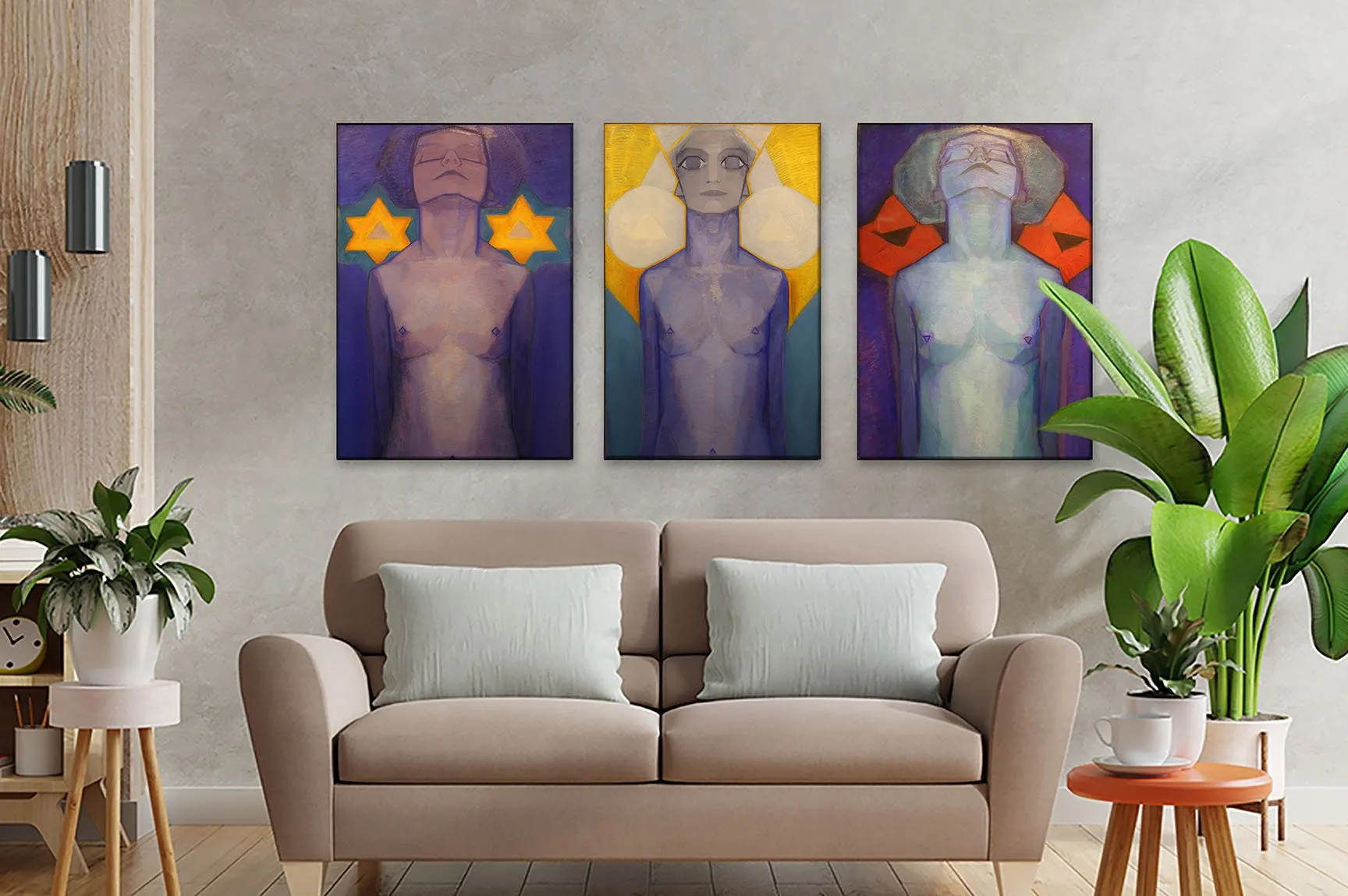
A single canvas is a statement. A set of canvases is a composition. When you split one image across two, three, four or five panels, the gaps, the rhythm and the overall width become part of the design, and choosing the wrong layout is easy to do when every shop uses slightly different words for the same thing.
This guide defines each layout, shows what happens to an image when it is divided, gives you the maths for gaps and total width against your furniture, explains the hanging order and a template method, and covers how a multi panel order is shipped. There are comparison tables, a hanging checklist and a decision guide.
Short answer: A diptych has two panels, a triptych three, and larger sets have four or five. Triptychs suit most spaces because the centre panel gives a natural focal point. Leave gaps of about 3 to 8 cm, size the whole group to two thirds to three quarters of the furniture width, and hang from the centre outward.
Key takeaways
- Odd panel counts (three, five) give a central focal panel. Even counts (two, four) put a join in the middle, so avoid centring a face or key subject there.
- Total width equals the panel widths plus the gaps. Gaps typically run 3 to 8 cm, and tighter gaps read as one image.
- For a 1.8 m sofa, aim for a group about 120 to 135 cm wide.
- Multi panel orders ship for one fee based on the largest piece in the order.
- Use a paper template, a spacer block and a level, and hang the middle first.
What diptych, triptych and multi panel actually mean
The terms come from art history. A triptych was originally a three panel artwork, often hinged, and the idea of dividing one scene across several panels has carried into modern canvas printing.
- Diptych: two panels, hung side by side or one above the other.
- Triptych: three panels, most often in a row, sometimes with a larger centre panel.
- Four panel set: four pieces, arranged in a row or a two by two grid depending on the product.
- Five panel set: five pieces, in a row or in a staggered arrangement, depending on the product.
Layouts vary by artwork, so the exact panel sizes and arrangement are shown on each product page. You can browse each type in our triptych canvas collection, the four piece canvas collection and the 5 panel canvas collection.
Layout comparison at a glance
| Layout | Panels | Gaps to plan for | Focal point | Best for |
|---|---|---|---|---|
| Diptych | 2 | 1 | A join in the middle | Narrow spaces, pairs of related images, spaces too tall for a wide row |
| Triptych | 3 | 2 | Centre panel | Above a sofa or bed, landscapes, the most versatile choice |
| Four panel | 4 | 3 in a row, or a cross shaped gap in a grid | A join, or the centre of the grid | Square or near square spaces, abstract and map style images |
| Five panel | 5 | 4 | Centre panel | Wide feature areas, bold images, big open plan spaces |
The practical rule: more panels means more width, more hanging work and more places for the picture to be interrupted. Fewer panels means a simpler job but less coverage.
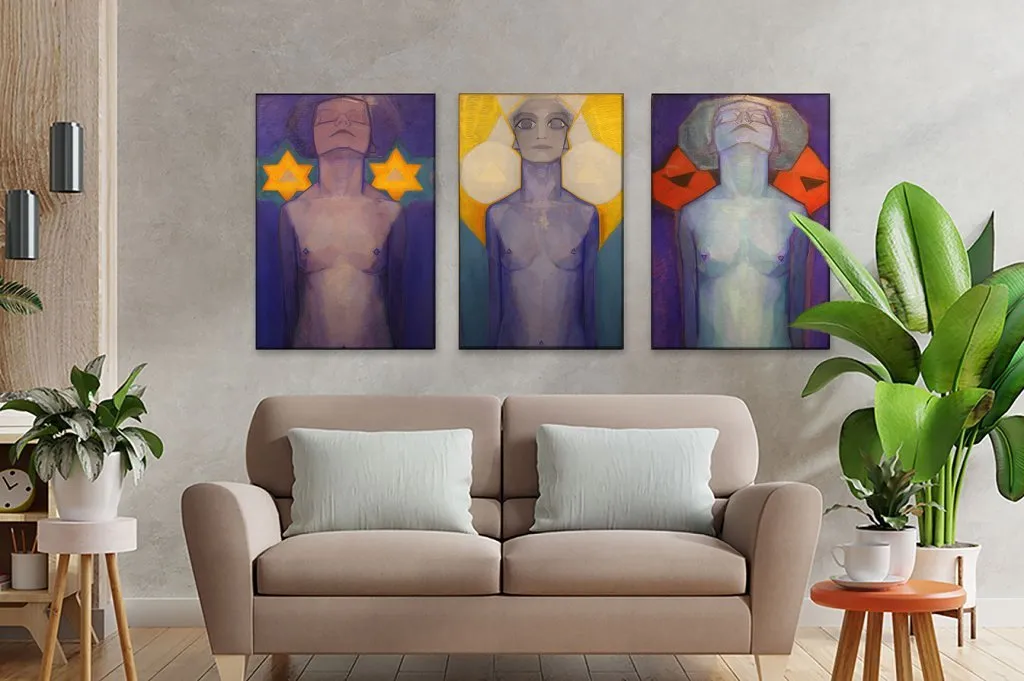 Evolution by Piet Mondrian is a triptych set, a layout where the centre panel anchors the group and two outer panels balance it.
How an image splits across panels
There are two styles of multi panel artwork, and it pays to know which you are buying.
One image divided across the panels
A single picture is cut into sections, and the panels are hung with a small gap. The gap hides a thin slice of the picture, so lines and shapes still seem to continue across it. This approach suits horizons, coastlines, skies, skylines and abstract or botanical images that flow from one panel to the next.
Related images that each stand alone
Some sets are three or more separate images that share a palette or theme. Each panel looks complete on its own and the gaps do not interrupt anything. Botanical series and colour studies often work this way. The Tropical Banana Leaf Triptych is an example of a set designed to be read as a group.
Each product page shows how the set is composed. If you are using your own photo, the proof we send before printing shows exactly where the cuts fall, and layout changes at proof stage are free. Printing starts only after you approve it.
Which images split well, and which do not
| Splits well | Splits badly |
|---|---|
| Horizons, coasts, mountains and wide landscapes | A portrait with the face on a join |
| Skylines and city panoramas | A single object exactly in the middle of an even count |
| Abstract art, texture and colour fields | Text or a quote that runs across a gap |
| Botanical and floral patterns | Group photos with people near the cut lines |
| Images with a strong centre panel subject in an odd count | Pictures with fine detail along the edges |
A reliable test: print the image on paper at a reduced scale, cut it into the panel pieces, and look at what lands on each cut. If a face, a hand or a word is cut, move the crop or change the count.
Odd or even: symmetry and the centre of the group
Odd counts have a centre panel. The eye lands there first, so it is the place for the strongest part of the image. Three and five panel sets feel balanced and stable, and they suit centred furniture such as a sofa or a bed.
Even counts have a join in the middle. That is fine for abstract or flowing images, but a join through a face or a centred object looks awkward. A diptych usually works best with two related images or a landscape in which the join falls on empty sky or water.
Some five panel and staggered sets use different panel sizes, with a bigger centre and smaller outer pieces. That gives movement and suits a wide space. It is also more complicated to hang, so use a template. For a broader look at arrangements, including unequal sets, our existing guide on multi panel canvas layouts is worth a read.
Gap spacing: how far apart should the panels be?
Gaps of about 3 to 8 cm are typical for a canvas set. This is a design guide rather than a hard rule, and you should follow the product page if it gives a recommended spacing. For gallery style groups of separate pieces we suggest 5 to 7 cm.
- 3 to 4 cm: reads as one image, with a clear continuous flow. Best for a single picture divided across panels.
- 5 to 6 cm: the safe middle ground. Panels look related but distinct.
- 7 to 8 cm: reads as separate pieces in a group. Better for stand-alone images and for large panels, where proportionally bigger gaps look right.
Keep the gaps equal everywhere. Uneven gaps are the quickest way to make a set look as if it were hung in a hurry. A thin cardboard spacer cut to the exact gap width is the best tool.
How much do gaps change total width?
More than people expect. In a five panel set with panels 25.4 cm (10 inches) wide, the panels alone take 127 cm. With the gaps added, the overall width is:
| Gap | Four gaps total | Overall width of five 25.4 cm panels |
|---|---|---|
| 3 cm | 12 cm | 139 cm |
| 5 cm | 20 cm | 147 cm |
| 8 cm | 32 cm | 159 cm |
A 5 cm difference in gap size changes the width of a five panel set by 20 cm. On a triptych the same change is 10 cm, and on a diptych only 5 cm. The more panels, the more the gap choice matters.
Planning total width against your furniture
The sizing guidance is the same as for a single piece: the whole group should be about two thirds to three quarters of the width of the furniture below it. Measure the furniture, then work backwards to panel width.
The formula: total width = (number of panels x panel width) + ((number of panels minus 1) x gap). Rearranged: panel width = (target total minus all the gaps) divided by the number of panels.
Here is that worked through for a 1.8 m sofa, where the target group width is 120 to 135 cm, with a 5 cm gap:
| Layout in a row | Gaps (5 cm each) | Panel width needed | Panel width in inches |
|---|---|---|---|
| Diptych (2) | 5 cm | 57.5 to 65 cm | 22.6 to 25.6 in |
| Triptych (3) | 10 cm | 36.7 to 41.7 cm | 14.4 to 16.4 in |
| Four panel (4) | 15 cm | 26.3 to 30 cm | 10.3 to 11.8 in |
| Five panel (5) | 20 cm | 20 to 23 cm | 7.9 to 9.1 in |
The point of the table is the trade-off. A diptych for this sofa needs two big panels. A five panel set needs five small ones. Panel sizes are set by each product, so use the table to see which layout is closest, then read the product page for the actual size.
Furniture widths and likely layouts
- 1.2 m console or narrow desk: a diptych or a compact triptych, 80 to 90 cm overall.
- 1.5 m queen bed: a triptych, 100 to 113 cm overall.
- 1.8 m sofa: a triptych or four panel set, 120 to 135 cm overall.
- 2.2 m sofa or wide feature area: a five panel set or a large triptych, 147 to 165 cm overall.
For a single wide canvas as an alternative, see panoramic canvas prints, and for the largest single sizes see large canvas prints. Our canvas print size chart converts between inches and centimetres.
Height and position
Treat the group as one object. Hang so the centre of the whole group is at about 145 cm from the floor, and leave a 15 to 25 cm gap between the furniture and the bottom of the lowest panel. For a two by two grid or a staggered set, measure the whole group’s height, not an individual panel.
 A set like the Tropical Banana Leaf Triptych reads as a rhythm of three panels, and equal gaps keep that rhythm clean.
How to hang a multi panel set
Multi panel sets are easy to hang badly. A one centimetre error in a gap is obvious, and a slight tilt in one panel stands out against its neighbours. The reliable method uses paper templates.
- Lay the set on the floor in the order you will hang it, with the gap width between each. Photograph it, so you have a reference.
- Make paper templates. Cut kraft paper or newspaper to the size of each panel, and mark where the hanging fittings will sit.
- Stick them up with painter’s tape in the final arrangement, using a cardboard spacer for each gap. Step back and look from the normal viewing distance.
- Mark the centre line of the furniture and the centre height (about 145 cm).
- Mark the fixing points through the templates, then remove them.
- Hang the middle panel first in an odd count. For an even count, hang the two panels either side of the central join first.
- Work outward using the spacer block, checking each panel with a spirit level before moving on.
- Do a final check with the level across the top edges of all the panels, not just each one.
Each canvas is delivered ready to hang. Bumpers help the lower edge sit square. For fixing types and tools, see our guides to hanging canvas prints and the ultimate how-to hang art guide.
Hanging order checklist
- Label the back of each panel with a small tag or masking tape: left, centre, right, or numbers.
- Work out which panel hangs first before you pick up a drill.
- Use the same type of fixing for every panel so the heights stay consistent.
- Measure from the centre line, not from the previous panel, so errors do not accumulate.
- Keep a second person on hand to hold panels while you check the level.
- Leave the protective film on until all of the panels are up, if that suits your process, and keep them out of direct sunlight.
Cost and shipping for multi panel orders
A set is a group of pieces, so check the product page for how it is priced. For the price of any set, use the product page or the Size and Price Guide, because prices depend on size and format.
Shipping is simpler than people expect. There is one shipping fee per order, based on the largest shipping size in the order, so a set of panels does not multiply the freight. Our shipping bands go by longest edge: Small up to 60 cm, Medium 61 to 90 cm, Large 91 to 120 cm and X-Large 121 to 152 cm. For example, a set whose largest panel is 76 cm on its longest edge sits in the Medium band, which in Perth metro is $40. Rates to other states differ, so check the shipping prices page.
- Production is typically 3 to 4 business days, with 2 business days extra for framed prints.
- Canvases are wrapped in protective film and boxed.
- Free studio pickup is available at Noosaville and Booragoon; choose Pick up at checkout and call ahead.
The shipping process in full is covered in how canvas prints are shipped and packed in Australia.
Which layout should you choose?
| Your situation | Best layout | Why |
|---|---|---|
| Above a standard sofa or bed, and you want one safe choice | Triptych | Central focal panel, flexible width, simple to hang |
| A narrow space such as a hallway nook or a short console | Diptych | Fewer panels, a smaller footprint |
| A near square space, or a map or abstract image | Four panel set | Works as a row or a grid |
| A wide feature area above a long sofa or sideboard | Five panel set, or a wide triptych | Covers the width and fills it with rhythm |
| A single wide scene such as a coast | Panoramic canvas, or a triptych of the same scene | The horizon flows across; see the panoramic guide |
| A group of photos of different shapes | A collage canvas | Fits mixed shapes in one piece; see how to plan a photo collage canvas |
| Renting, with limited hanging options | A single canvas or a diptych | Fewer fixings to place and fill |
If the space is open plan and the art needs to define an area, our existing post on why triptych landscape canvases suit open plan spaces is a useful companion.
Frames, wraps and finish for a set
All panels in a set should share the same wrap or frame, otherwise the group looks accidental. Stretched canvas comes with a choice of mirror wrap, gallery wrap (50 mm of the image wraps the timber) or a coloured border in black or white, at the same price. See the wrap options page.
A floating frame, which holds a stretched canvas in a frame with a small visible gap around it, with frame colour options on the product page, changes the look of the gaps between panels. Allow for it in your layout, and see our floating frame vs standard frame comparison. For choosing a colour that suits a group, read how to choose a frame colour for art prints.
 Dark, flowing subjects like the Midnight Jellyfish Triptych show how a shared palette ties three panels into one group.
Common multi panel mistakes
- Gaps that are too wide. Beyond about 8 cm, a divided image stops reading as one.
- Hanging each panel by eye. Use templates and a spacer.
- Choosing a set that is too narrow. A three panel set that covers less than half the sofa looks lost.
- Ignoring the join. An even count puts a split in the middle.
- Measuring only the panel, not the whole group, when setting the height.
- Forgetting the wrap. A floating frame changes the visual gap.
- Not checking the proof. With your own photo, review where the cuts fall before approving.
Frequently asked questions
What is the difference between a diptych and a triptych?
A diptych has two panels and a triptych has three. A triptych has a centre panel, which gives a natural focal point, whereas a diptych has a join in the middle.
How far apart should I hang triptych panels?
About 3 to 8 cm is typical. Use 3 to 4 cm for one image divided across the panels and 5 to 7 cm for separate pieces. Keep every gap identical.
How wide should a triptych be above a sofa?
About two thirds to three quarters of the sofa width, which is 120 to 135 cm above a 1.8 m sofa. Include the gaps when you add up the width.
Can I split my own photo into a triptych?
Yes, for personalised work we send a digital proof before printing, usually within 2 business days. You can check where the cuts fall and ask for free layout changes before approving.
Which photos work best as a triptych?
Landscapes, seascapes, skylines and abstract or botanical images, because the picture flows across the gaps. Avoid putting a face or key detail on a join.
Do I pay shipping for every panel?
No. There is one shipping fee per order, based on the largest shipping size in the order. A set ships as one order, so the fee depends on the longest edge of the biggest panel.
How high should a multi panel set hang?
Centre the whole group at about 145 cm from the floor, and leave 15 to 25 cm between the furniture and the lowest panel. Measure the height of the entire group, not one panel.
How do I hang several canvases straight?
Make paper templates, tape them up, and use a cardboard spacer for the gaps. Hang the middle panel first and check each panel with a spirit level.
Is a 5 panel canvas too much for a small space?
Usually yes. Five panels need about 120 cm or more of width, and the panels shrink as you fit more in. In a small space a triptych or diptych is a better choice.
Are multi panel canvases ready to hang?
Yes. Stretched canvases arrive ready to hang, once you have placed your fixings on the wall.
Choosing your multi panel layout
For most spaces, a triptych is the safest and most flexible choice. Go to five panels only when the area is wide and you want a bolder statement, and use a diptych when width is tight. Work out your total width first, decide on a gap, and check where the image will be divided.
When you are ready, browse the triptych canvas range, try a set such as the Midnight Jellyfish Triptych, and read the canvas size guide before you measure. Our team can help with layouts on 1300 632 332 or through the contact page.
Browse every guide in our series on the canvas print guides page.
